Authentic Belonging and Community-Building for grade 2 students
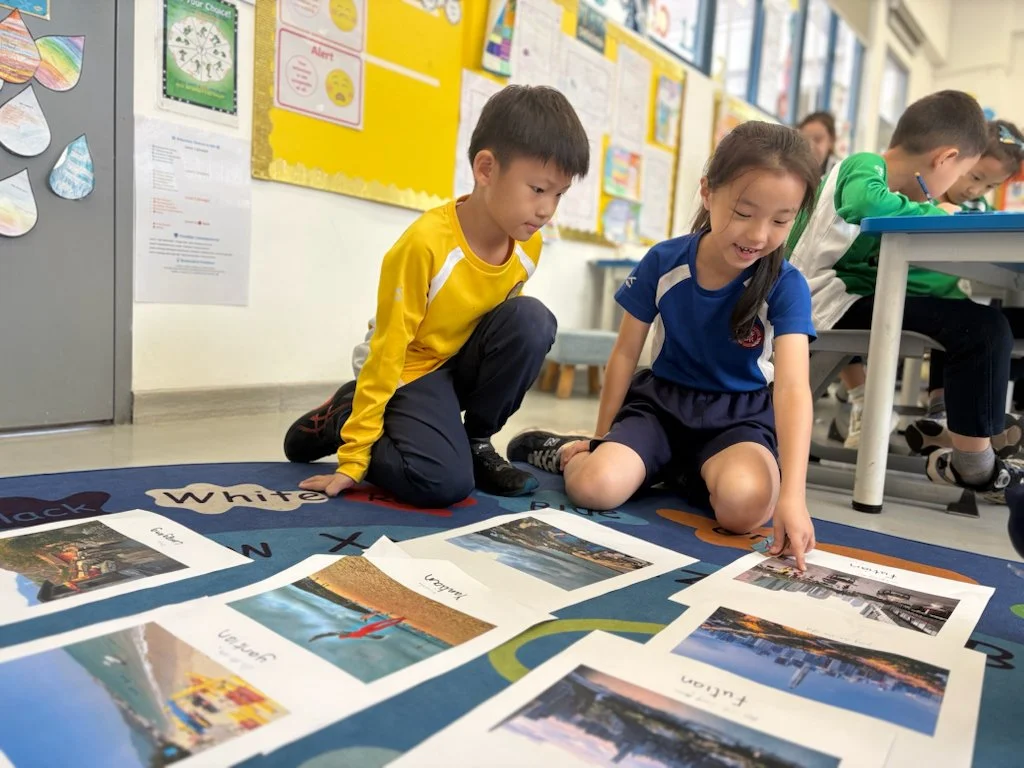
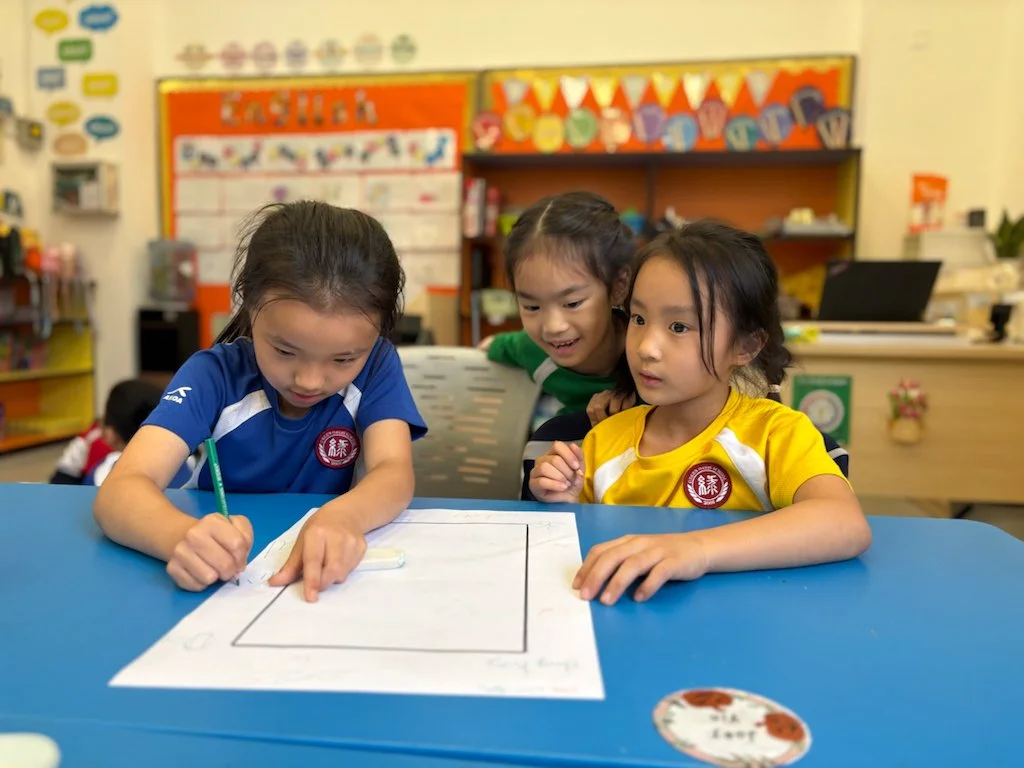
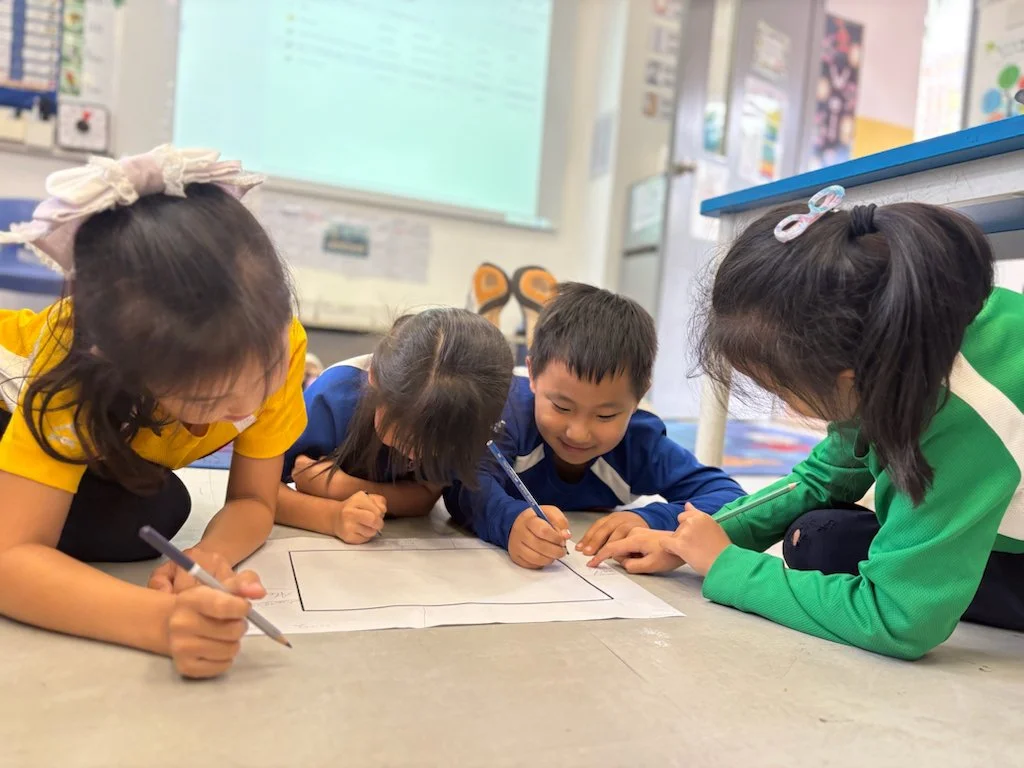
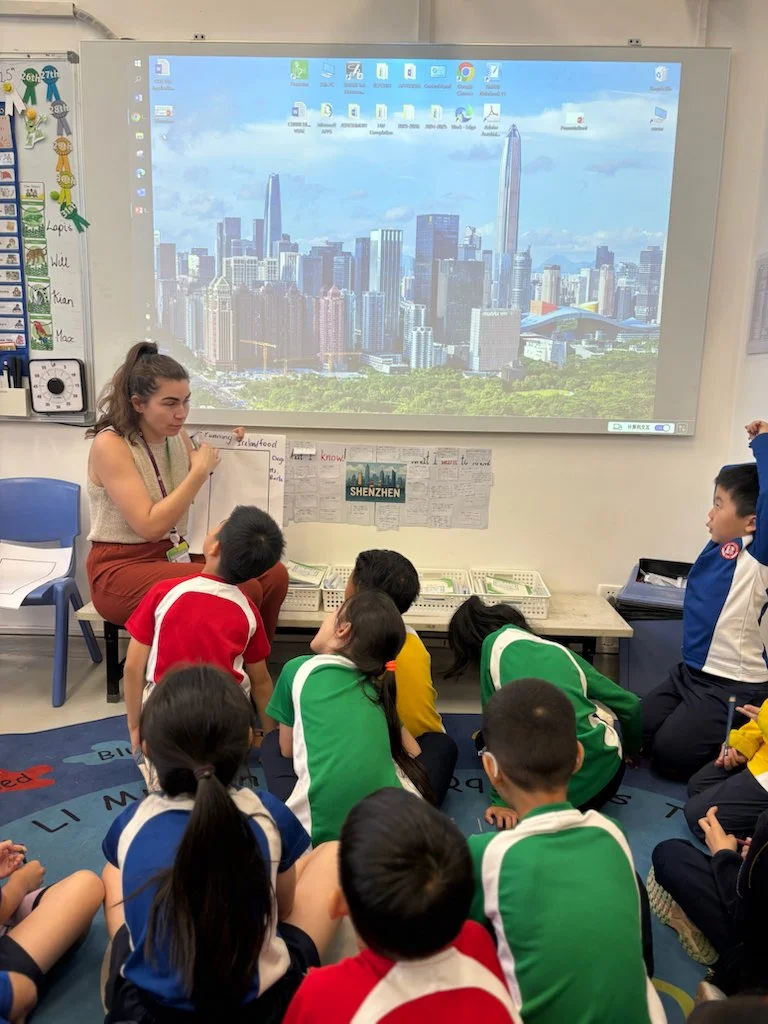
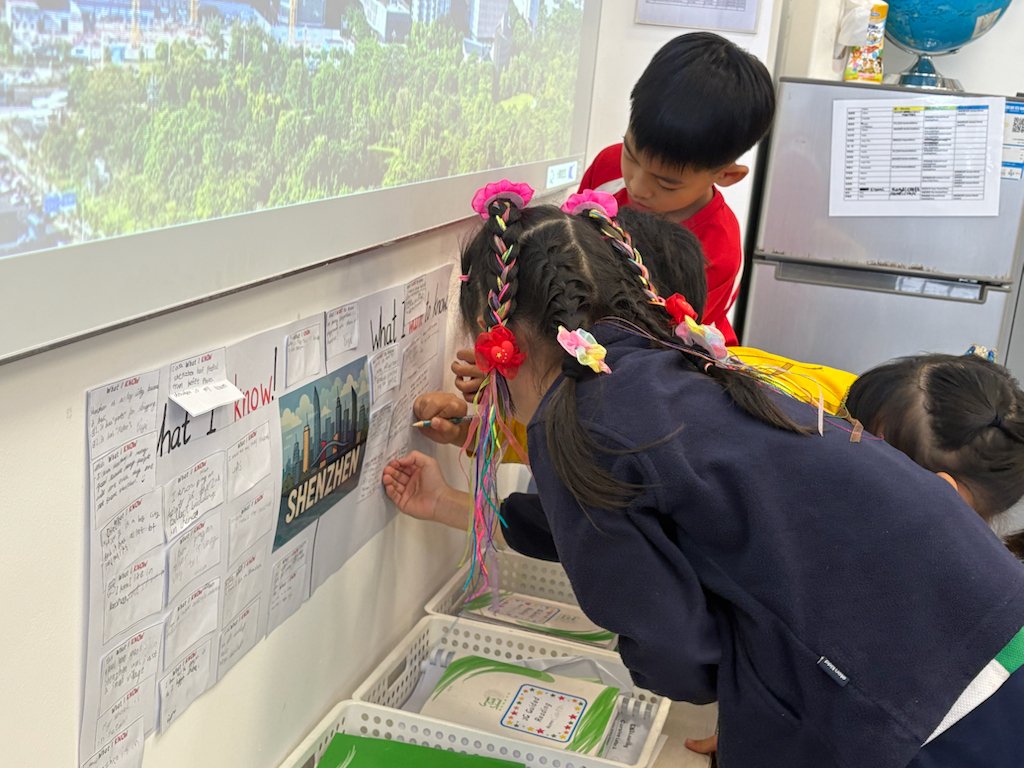
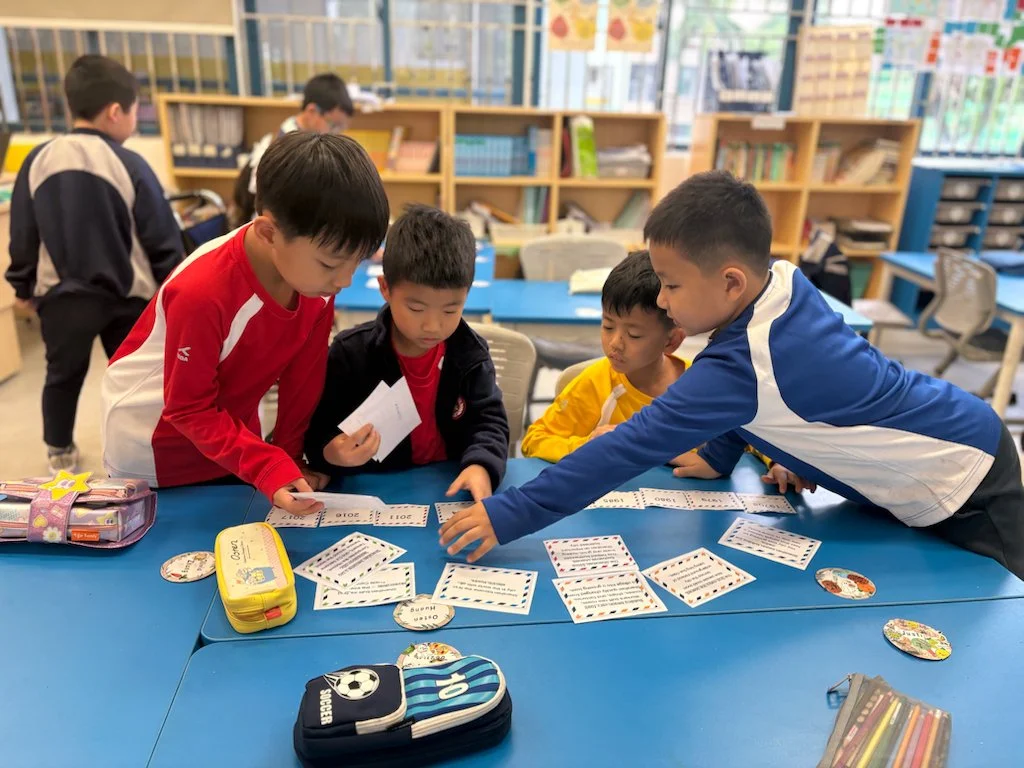
Students engaging in some inquiry investigations about the city of Shenzhen in China, where Green Oasis School is located.
When the Year 3 (grade 2) teaching team at Green Oasis School in Shenzhen, China, sat down to plan their second unit of the year, they knew they wanted to create something meaningful about their city. What they didn't anticipate was how a shift in framing would transform not just the unit itself, but their students' sense of agency, empathy, and connection to place.
The Challenge: Moving Beyond The Surface
Like many international schools teaching about their host city, the initial unit plan focused on Shenzhen's features: its skyline, its history as a fishing village turned innovation hub, its landmarks and geography. The learning outcomes were clear and appropriate for Grade 2 students: understanding human and physical features, demonstrating spatial awareness, and communicating about their city.
But something felt incomplete.
The team wondered: How do we help students see Shenzhen not just as a place they learn about, but as a place that shapes who they are, and that they have a responsibility to care for?
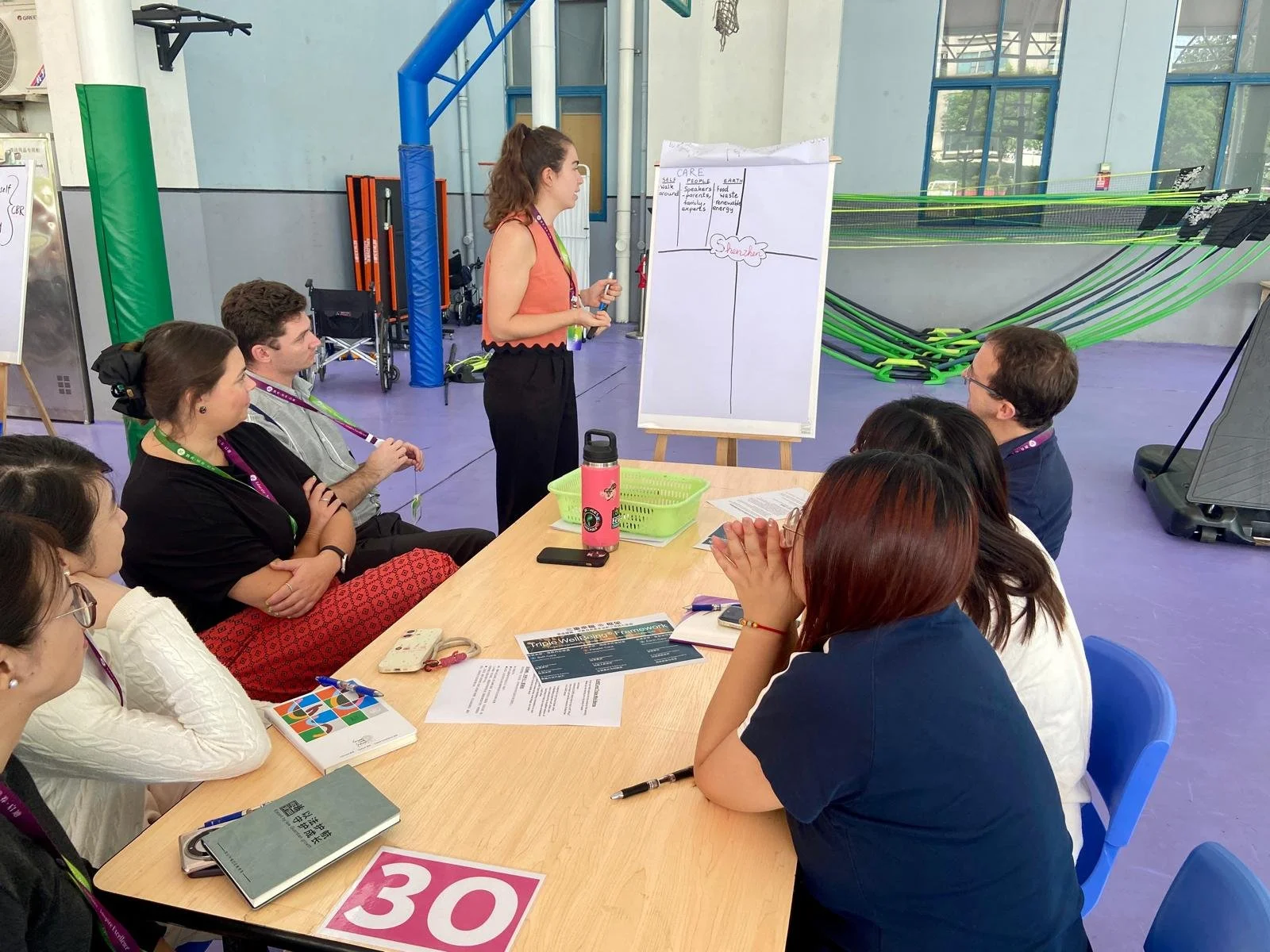
Year 3 (grade 2) team leader Hannah Sheridan (standing) and the rest of the year 3 team as they engage in ideation about redesigning an assessment to amplify engagement, community impacts, and deep learning.
The Shift: A Question That Changed Everything
Working with community engagement and storytelling consultant LeeAnne Lavender, the team began to reimagine the unit through three interconnected lenses: belonging, identity, and planet care. These became the heart of the redesigned unit.
The breakthrough came with a single guiding question that would anchor the entire nine weeks: "How do we belong to the places that shape us, and how can we care for them in return?"
This question did something powerful: it centred the student experience ("How do we belong") while honouring reciprocity (the idea that places give to us and we have responsibility back). It was regenerative thinking made accessible for seven- and eight-year-olds.
The Framework: Head, Heart, Hands
To structure the redesigned unit, the team embraced a Head, Heart, Hands approach that wove through every week:
HEAD (Knowledge): What students need to understand about Shenzhen, their community, and sustainability
HEART (Values): How students connect emotionally to belonging, identity, and care
HANDS (Action): How students take meaningful action in their community
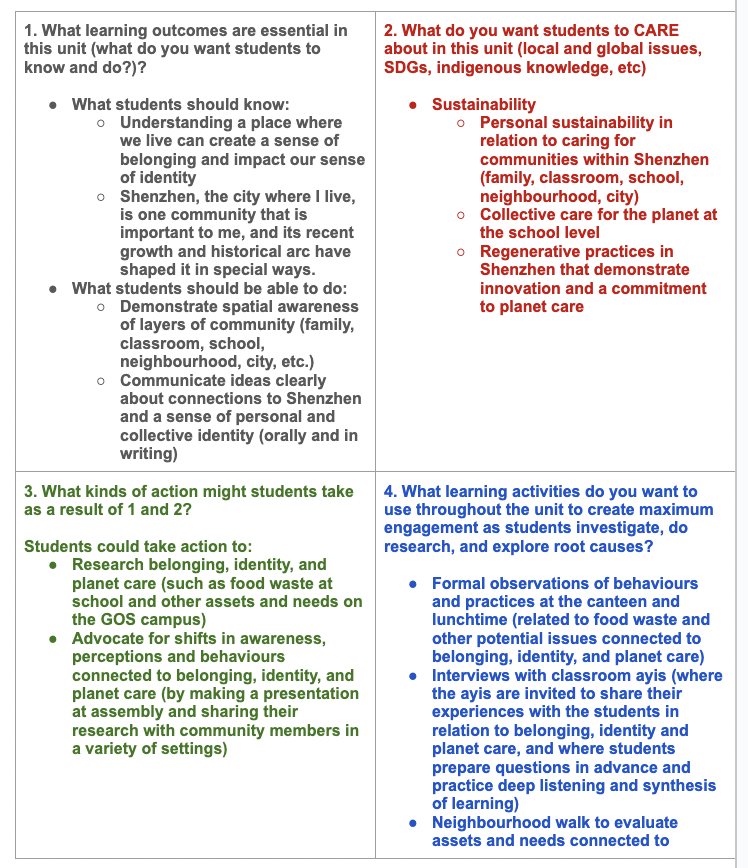
This framework ensured the unit wasn't just about accumulating knowledge, but about transformation. You can see the ideation process in the screenshot below; these were ideas the team designed with me during our initial coaching call.
What Changed in Practice
The redesign maintained the solid geography content of the unit but embedded it within community-engaged learning experiences:
From Map Skills to Community Mapping
Instead of just labelling features on a map, students went on neighbourhood walks to evaluate assets and needs connected to belonging, identity, and planet care. They weren't tourists observing, but community members investigating.
From Learning About Shenzhen to Learning From Shenzhen
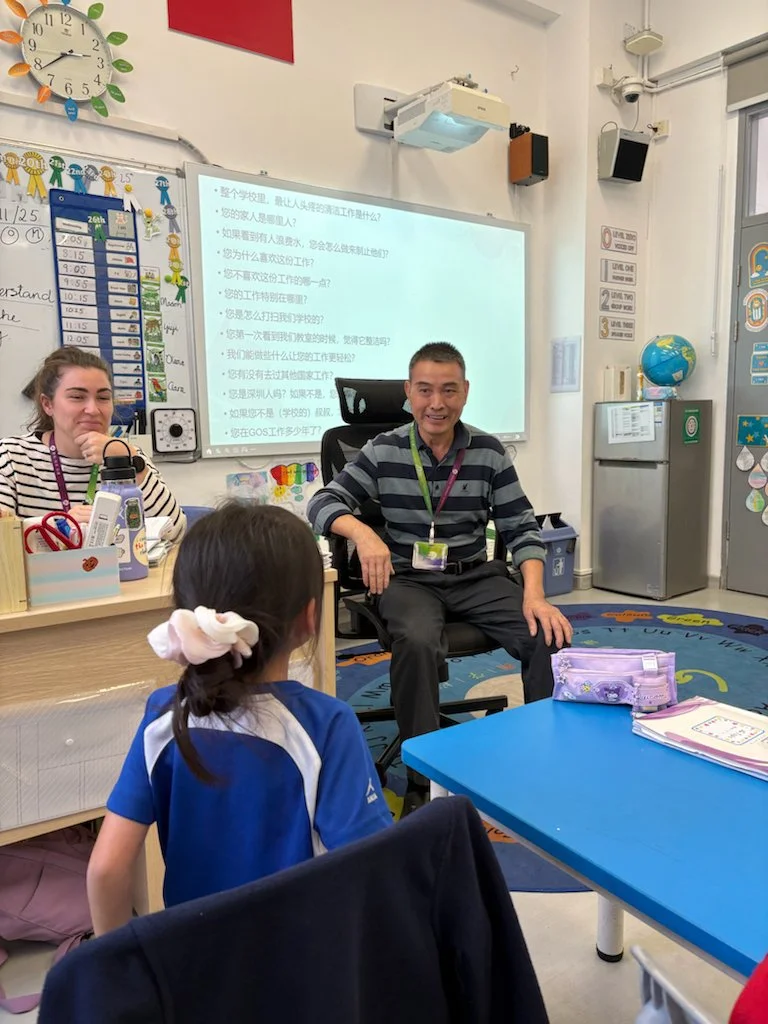
Students conducted deep listening interviews with school ayis who clean the classrooms and other areas of the school, asking about their experiences of belonging and community. They prepared thoughtful questions in advance and practised synthesis of what they learned. These conversations were an integral part of a genuine investigation into diverse perspectives within their school community.
As a result of these interviews, authentic belonging has been fostered. One teacher on the Year 3 team, Jordan Tasker, says: “The ayi who cleans my classroom says hello to me a lot more now, and when she sees students from the class, she’s excited. Our relationship with her has shifted because of the interviews.”
Year 3 team leader Hannah Sheridan agrees: “Yes, the ayis were valued and honoured by the interviews the students did, and it was such a good thing to bring the school community closer together.”
From Observation to Action
Perhaps most significantly, students conducted formal observations and research around food waste in the school canteen. They collected data, analyzed patterns, researched root causes, and began to advocate for shifts in awareness and behaviour.
Below: photos from various class periods and experiences where students investigated Shenzhen through active inquiry and research.
The Impact: What the Team Discovered
When the Year 3 team reflected on the unit in January, their observations revealed transformation at multiple levels:
Student Engagement Soared
Conducting interviews with the school ayis and creating Chatterpix videos about Shenzhen buildings were experiences that students really leaned into. The team noted "increased engagement and learning" because students weren't performing for the teacher; they were investigating questions and issues that mattered to them.
“The students really enjoyed having more autonomy in this unit,” says Hannah. “They were all working toward the same objective, but got there in so many different ways, and I think that was powerful.”
“For the interviews with ayis, my students came up with a ton of questions, and I have never seen them that enthusiastic about wanting to learn more,” adds Year 3 teacher Edward Bell. “The interviews allowed the students to care, and this really led them to think about caring for the community, and it was so great to see that.”
Edward’s students were also very engaged with using the Chatterpix app to share stories of the Shenzhen buildings they researched. “They enjoyed Chatterpix so much,” he smiles. “They had the freedom to add stickers and other elements, and the app is so intuitive that they could use it easily. They took their creative expression in directions I couldn’t have imagined, and it was wonderful to see this creativity.”
Learning Became Authentic and Layered
One team member reflected that the unit was "an ongoing process of discovery and evolution" for both the students and the teachers, too. The guiding question about belonging helped anchor the work, though the team recognized they would like to explore the "belonging" aspect even more deeply in future iterations.
Student Agency Emerged Organically
The team identified that students needed more time for their "action-oriented sustainability projects." Time can often seem like a scarce resource as we engage in curricular units, and in this case, it was evident that students had so much they wanted to do that the original timeline couldn't contain it all. When students have genuine agency, they push beyond the boundaries we set, and the Year 3 team would like to carve out more time for this unit next year so they can honour the action and sustainability components of the plan in more meaningful ways.
Integration Worked Seamlessly
By weaving English (persuasive and informational writing), social studies (geography and sustainability), and PSHE (wellbeing and relationships) around the central question of belonging and care, the team created a genuinely integrated unit rather than parallel subjects sharing a theme.
This became very clear in the summative assessment for the unit, which involved a number of modes that students could use to demonstrate their learning. Year 3 teacher Amanda McGain says, “I think it was powerful that the students realized they could show their learning in a variety of ways, not just in writing.”
“Many of our other units are very test-based in terms of summative assessment, and not everyone does well with this type of task, so I think the fact that students could express themselves in different ways with this unit was really positive,” adds Edward.
Teachers assessed the students’ Chatterpix videos, their interviews with ayis (through recordings of each interview), and leaflets created by students about Shenzhen as three summative components of the unit. They also shared the Chatterpix videos and leaflets on Toddle so parents and community members could share in the learning process.
As a final reflection in this unit, the teachers had students participate in a discussion about the unit’s central question at the very end of the learning cycle. Hannah says they might like to ask students to do a deeper reflection on the central question in future versions of this unit, but that this year, the conversations were a good way for students to pause and consolidate learning before the Christmas break.
Below: some Chatterpix examples of student-created videos about landmark buildings in Shenzhen. The festive decorations in the videos reflect the season in which the videos were created, and how excited the students were about their upcoming Christmas holiday. :)
Honest Reflections: What They'd Adjust
The team celebrates what went well with this unit redesign and has also identified concrete areas for growth. Next year they’re aiming for:
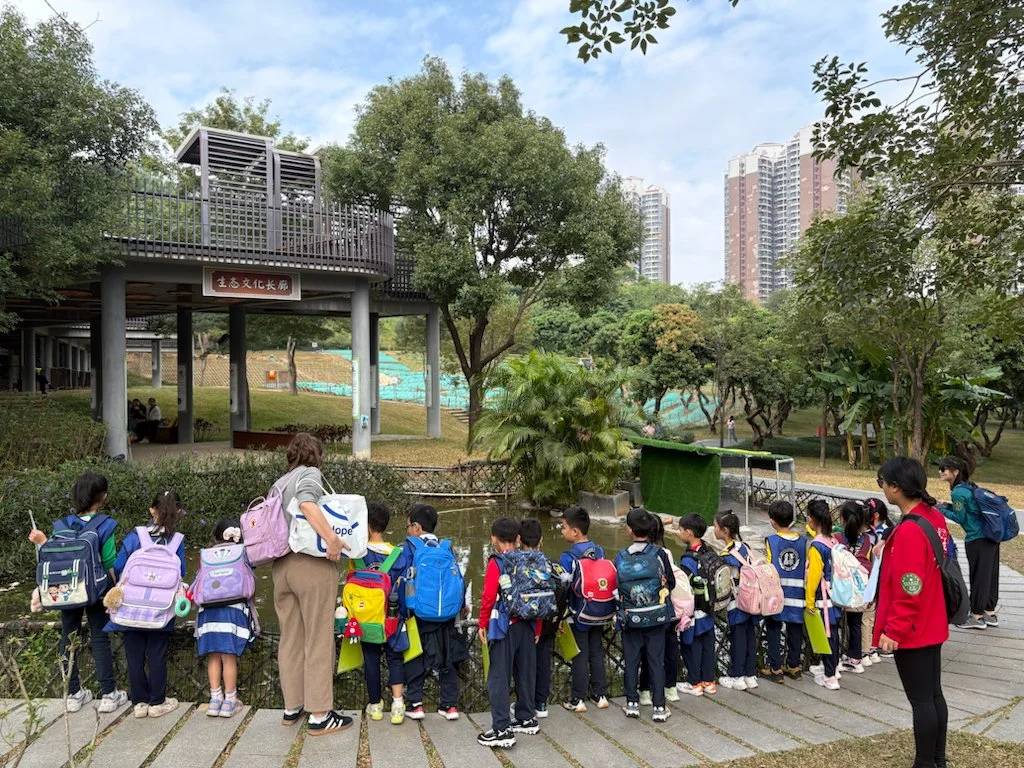
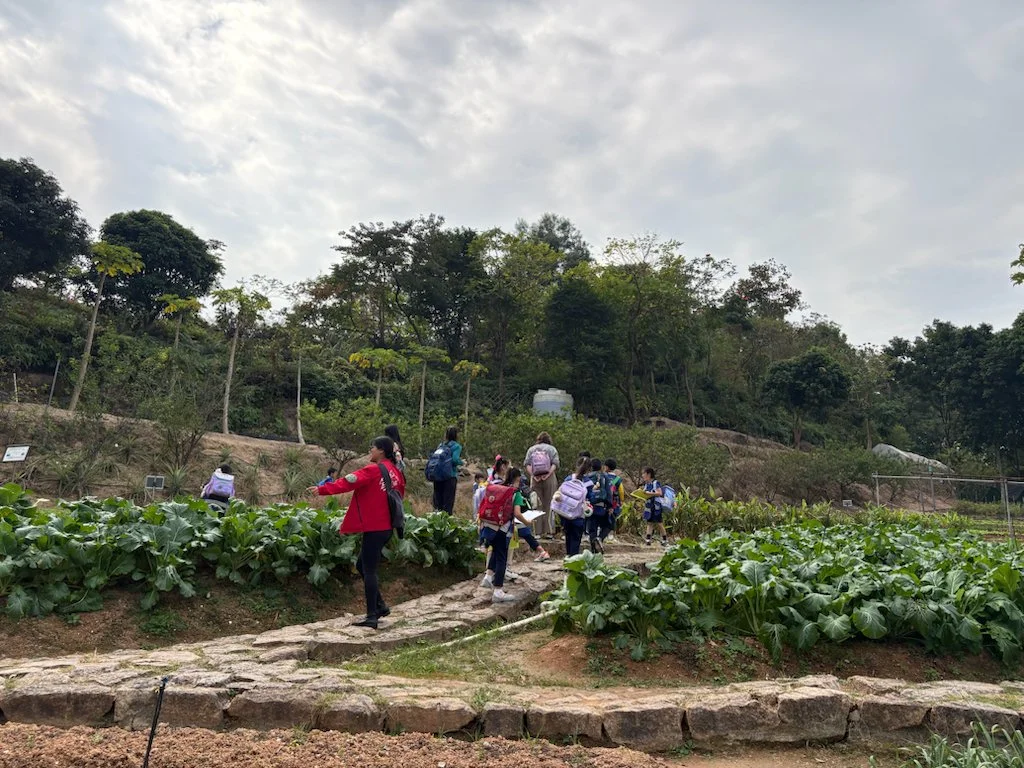
Better integration of the field trip experience to Xili Eco Park into the overall arc of learning
More time for student-driven action projects
Starting the initial planning meetings earlier to have more preparation time
Going deeper with the "belonging" lens, which sometimes got overshadowed by the action focus
These reflections demonstrate exactly the kind of iterative, reflective practice that leads to continuous improvement. The team isn't treating this as a "finished" unit to be repeated but as a living framework to be refined.
Below: photos from the field trip to Xili Eco Park in Shenzhen, which gave students a chance to connect to a local natural environment.
Looking Forward: Applying the Learning
Perhaps the most exciting outcome is what comes next. The team shared that they're already planning to apply the Head, Heart, Hands framework and principles of authentic community engagement to their upcoming Bronze Age/Iron Age and Tremors units. They're asking: How do we integrate global citizenship principles and more inquiry-driven, project-based learning into these units, too?
This is how sustainable change and culture shifts happen in schools: through teachers internalizing new approaches, prototyping new strategies and experiences, reflecting in a meaningful way, and applying what they’ve learned across the curriculum.
Key Takeaways for Curriculum Designers
This redesign offers valuable lessons for any team reimagining place-based learning:
1. A Powerful Question Can Anchor Everything
The guiding question ("How do we belong to the places that shape us, and how can we care for them in return?") gave coherence to nine weeks of diverse learning experiences. The question supported students (and teachers) in understanding why they were doing what they were doing.
2. Integration Requires Intention
This wasn't a unit where geography happened on Tuesdays and writing happened on Thursdays. Knowledge, values, and action were woven through every learning experience in an interdisciplinary way. Students wrote because they had something meaningful to communicate. They learned geography through inquiry and investigation.
3. Community Engagement Isn't an Add-On
The interviews with ayis, the canteen observations, the neighbourhood walks, and the field trip: these experiences allowed students to engage with real community members, issues and places, which created reciprocal and relational learning.
4. Action Should Be Student-Driven and Authentic
Awareness about school food waste emerged from student research and observation. This is at the heart of authentic global citizenship and community engagement: investigating root causes and taking informed action.
5. Reflection Is Essential for Growth
When the team met with LeeAnne on a Zoom call in January to reflect on the unit, the team revealed a group commitment to continuous improvement. They celebrated what worked and identified what to adjust. They valued the coaching process not because it gave them a perfect unit, but because it gave them new lenses to apply to future work.
What the Year 3 team at GOS discovered is that connection to place doesn't happen through learning facts or approaching a place like a tourist. It happens through:
Asking questions that matter
Listening deeply to diverse voices
Investigating root causes, not just symptoms
Taking action that's informed by research and relationship
Reflecting on how place shapes identity
In reimagining their Shenzhen unit, this team didn't just teach students about a city. They helped seven- and eight-year-olds understand themselves as community members with agency, as listeners with empathy, and as change-makers with responsibility.
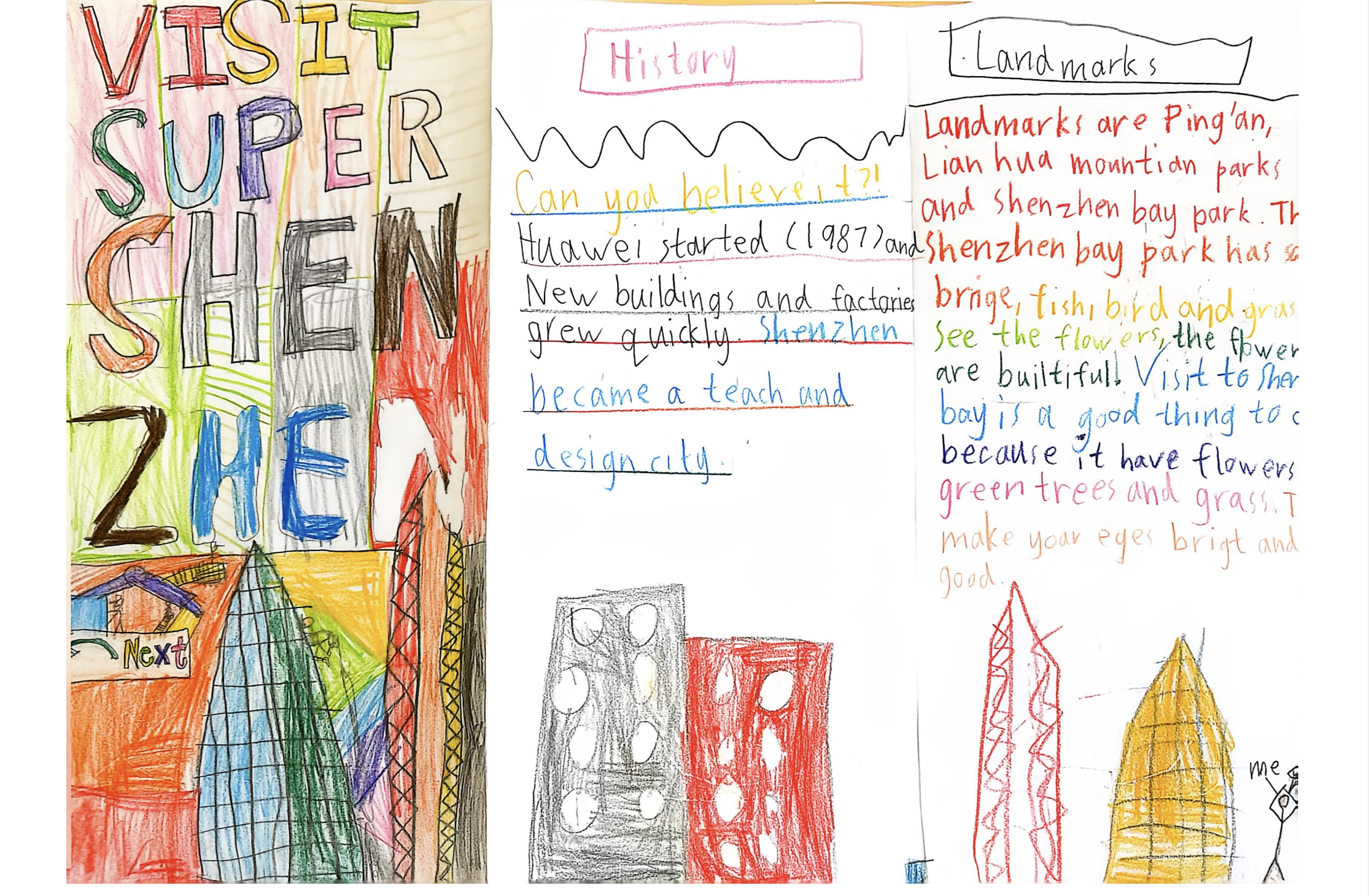
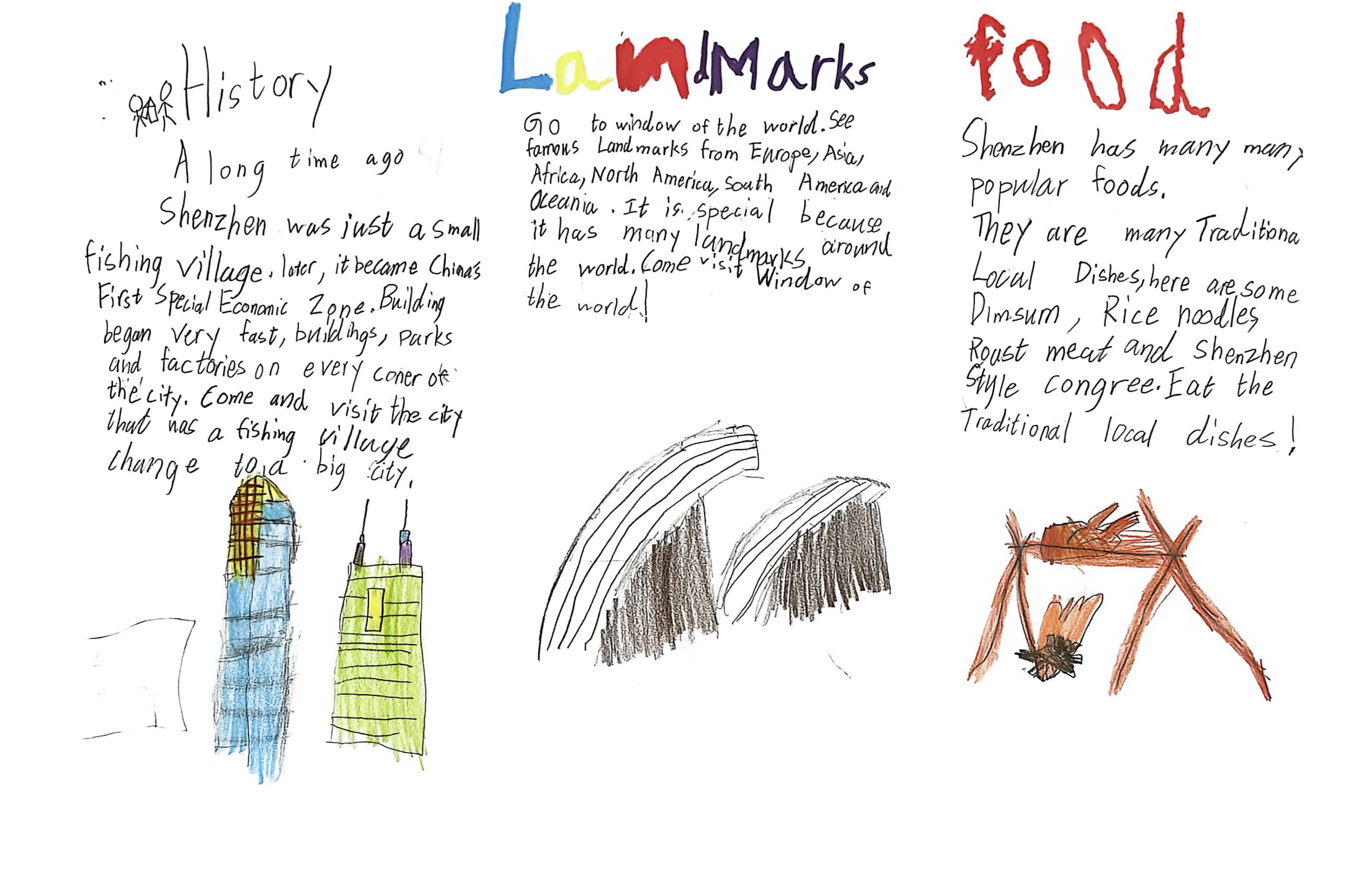
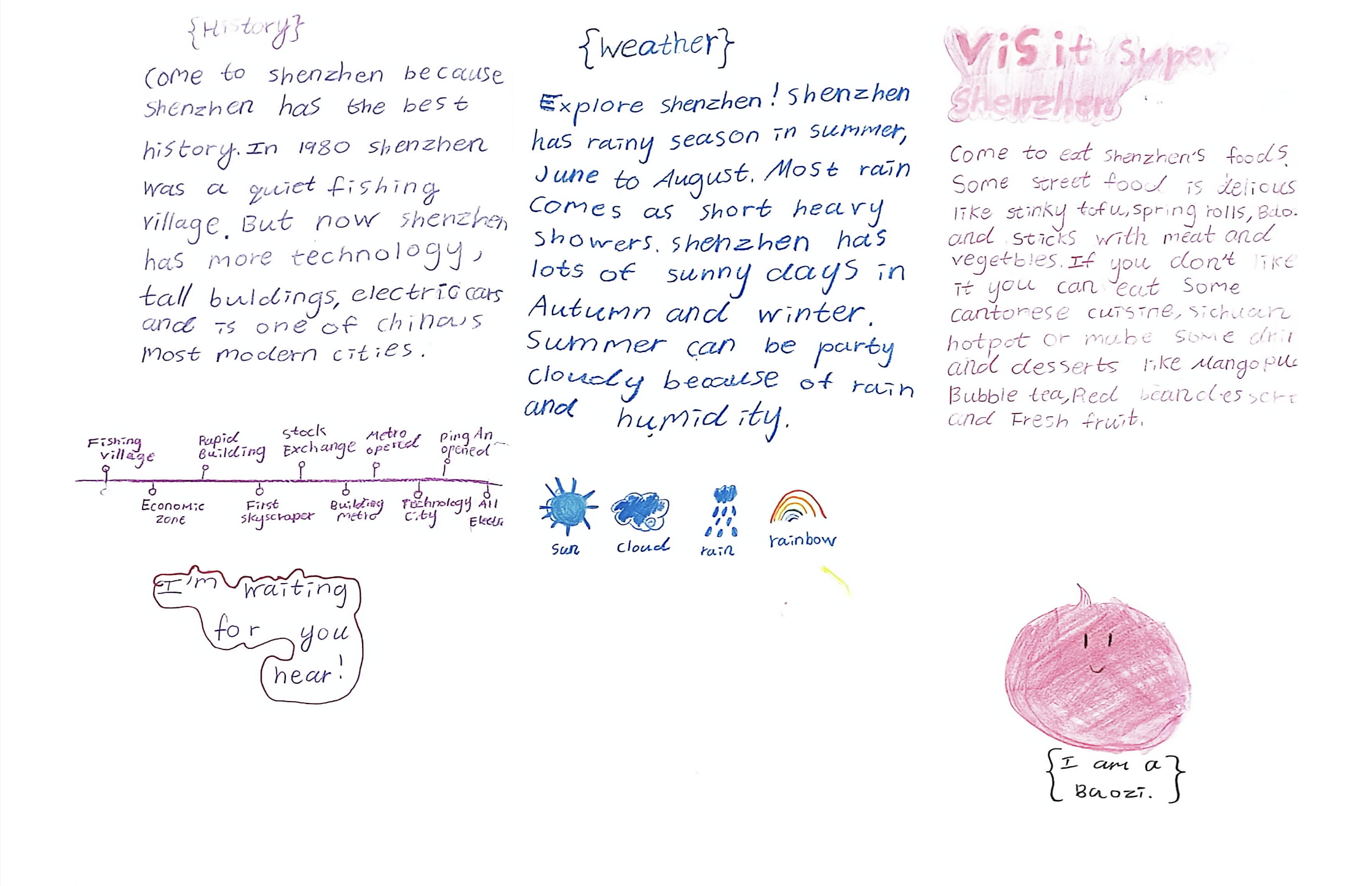
Below: pages from three Shenzhen brochures created by students to synthesize learning about the city where they live, and their understanding of how they can belong to this urban community.
This story is based on authentic curriculum redesign work conducted with the Year 3 team at Green Oasis School in Shenzhen, China, through its partnership with me (LeeAnne!) as a curriculum consultant and coach. The unit "Places That Shape Us: Belonging, Identity, and Care in Shenzhen" was implemented in the autumn of 2025, with reflection and iteration continuing into 2026.