Seeds of Change through Bokashi Composting & a Reciprocal Partnership
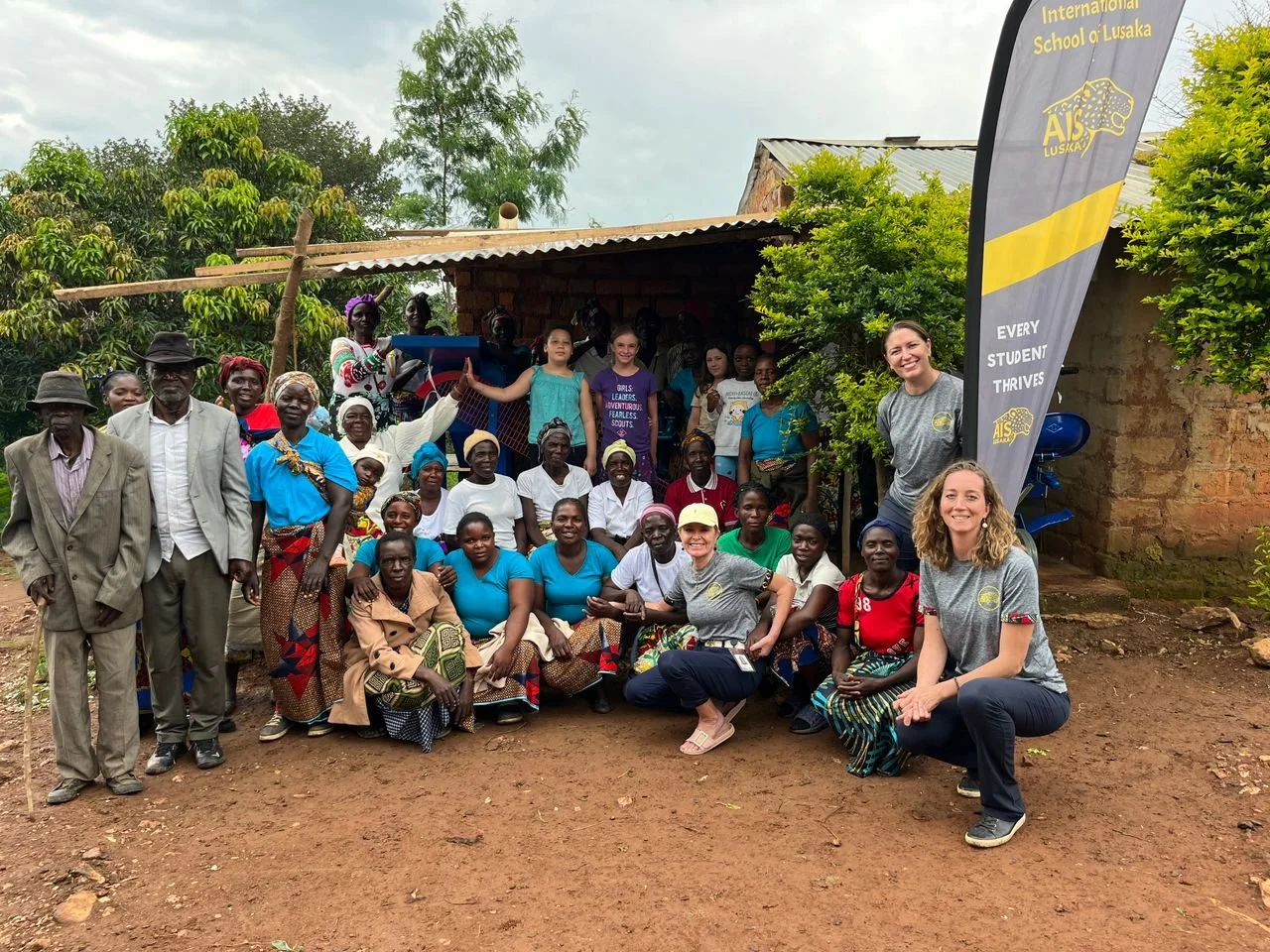
AISL teachers and students with members of the Shantumbu Women’s Group in Lusaka, Zambia.
When students at the American International School of Lusaka (AISL) in Zambia began collecting fruit peels and vegetable scraps in small green bins, they had no idea their composting project would blossom into a transformative partnership that would teach them as much as it would support a variety of community partners.
The school's Roots & Shoots Wildlife Club has developed a remarkable relationship with the Shantumbu Women's Group through their shared work in sustainable agriculture, with Game Rangers International (GRI) serving as the vital bridge between these two communities. What makes this partnership special isn't just the environmental impact; it's the genuine reciprocity that has both sides learning, growing, and celebrating together.
From Small Buckets to Big Impact
The composting journey began modestly, as teacher Anne-Marie Phiri van Hooijdonk recalls: "We started with just two buckets, and it wasn't very consistent."
As students became more engaged and the school's tuck shop (cafeteria) joined the effort, the small-scale operation quickly outgrew its containers.
Today, the students have designed and built their own large-scale Bokashi composting system using rectangular storage bins they crafted in the school's design room. The results are impressive, and they now produce approximately 20 litres of concentrated fertilizer regularly, fertilizer so potent it must be diluted 100 times before use.
"Before the Bokashi project, I used to put my fruit and vegetables in the bin," explains one fourth-grade student. "But now there's a way that we can compost and help the environment."
The timing of their success couldn't have been better. As the interview for this blog post was taking place, a delivery of 20 one-litre packs of fresh Bokashi fertilizer arrived at the school, a serendipitous moment that highlighted just how productive the school’s composting system has become.
A Partnership Rooted in Community Partnerships
The partnership with Shantumbu and GRI extends far beyond composting. Through fundraising efforts, the students have helped provide sewing machines for the women's group, and their success has inspired others in the school community to contribute additional equipment. The women now create products that are sold not only locally but have even been sent to conferences in Washington, D.C.
The community also operates a hammer mill that was supported through the partnership, a game-changing addition that means community members no longer have to walk long distances to grind their maize. As Christina from GRI explains, “this equipment generates profit for the women while serving the broader community's needs.”
Learning Flows Both Ways
For Naomi from the Shantumbu Women's Group, the partnership has been transformative: "I used to use fertilizer. Now I've stopped using fertilizer. I'm not using [chemical fertilizer] because the compost worked for me very well. Using it, we had very good vegetables."
The women grow Chinese cabbage, pumpkin leaves and other greens in their gardens, selling their produce both within their community and at markets in nearby towns. Some are also part of chicken-rearing cooperatives that involve selling eggs, and others are engaged with a small bakery. All of these initiatives are part of a diversified approach to sustainable livelihoods.
Students from the AISL Roots and Shoots Wildlife Club have visited the community a few times. It’s located about 1 hour and 45 minutes from the school, and during their visits, they have had a chance to learn about the community and its assets and needs. Because of the Bokashi system at school, the students have learned a lot about sustainable food and agriculture, and by visiting the community, they have learned about Zambian culture and social entrepreneurship, as well.
One fifth-grader observed, after visiting the community and talking with the women: "They're very strong, and they never give up."
Maya Monteroso, an inclusion teacher at AISL, notes how students experience some of the challenges of rural life firsthand through the community partnership: "When we visited during the rainy season, the kids got a first-hand experience from a slippery, muddy walk up to the village. They got to experience how life can be quite challenging in a small, rural community, and also the spirit of the community members... they persevere, they're strong, they don't let anything get them down."
The Ripple Effect
Christina from Game Rangers International, a long-term community partner with AISL and its Wildlife Club, emphasizes how this partnership aligns with broader conservation goals.
“For us to attain our conservation goal, we have to work together as a community,” she says. “If we hold hands with AISL and the people from the Wildlife Club, it helps us achieve something even greater."
The partnership addresses multiple interconnected challenges: reducing food waste, creating sustainable fertilizer, supporting alternative livelihoods that reduce pressure on natural resources, and building understanding across different communities.
Perhaps most importantly, it's teaching AISL students that they have agency in creating positive change. As one student powerfully noted: "Some people, they say that only adults can do it, but it's actually also kids who are able to help the community."
A Model for Reciprocal Partnership
What makes the AISL-Shantumbu partnership exemplary isn't just its environmental or economic impact; it's the genuine reciprocity that ensures both sides benefit and learn. The students gain practical knowledge about sustainable systems, experience different ways of life, and develop empathy and intercultural awareness. The community gains resources, markets for their products, and recognition of their expertise and resilience.
As the students continue to fill their green bins with vegetable scraps each day, they're creating compost while also cultivating relationships, understanding of community assets and needs, and proving that when partnerships are built on mutual respect and genuine listening, everyone can flourish.
AISL teachers and students are excited about the success of the club’s composting program and about the robust nature of the GRI/Shantumbu partnership, and they’re looking forward to creating a plan to put their abundant stock of concentrated compost to work in as many gardens as possible in and around Lusaka.
The Roots & Shoots Wildlife Club at the American International School of Lusaka continues to strengthen its partnership with the Shantumbu Women's Group through Game Rangers International, demonstrating how environmental action and community development can grow together when rooted in reciprocity and respect.