When Stories Build Bridges: Identity and Belonging through Community Engagement
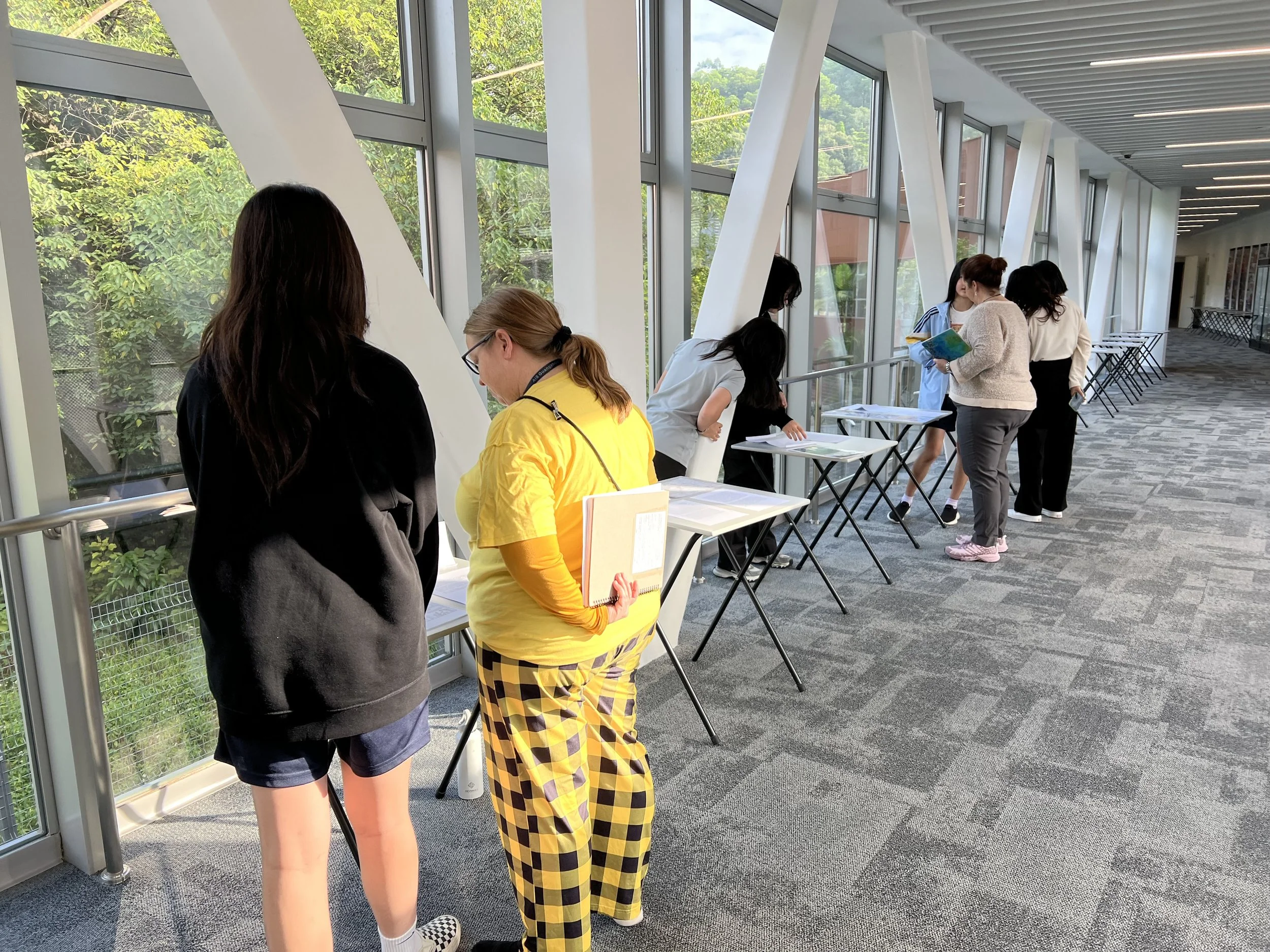
Students share graphic novel panels from interviews with non-teaching staff as a summative experience in their 8th-grade Language & Literature unit about identity and belonging.
Cassie Eagan and Burke Reed are eighth-grade Language and Literature teachers at the American International School of Guangzhou. They are participants in a year-long Service Learning and Community Engagement Specialist Certification Program as part of an AISG cohort, and continue to explore how community engagement can be authentically embedded throughout their curriculum. The Certification Program is designed and facilitated by me, Cathryn Berger Kaye, and Shei Ascencio.
At the American International School of Guangzhou, two 8th-grade Language and Literature teachers recently transformed a familiar unit into something extraordinary. Cassie Eagan and Burke Reed redesigned a unit rooted in a core text (the graphic novel American Born Chinese by Gene Luen Yang) using community engagement and storytelling strategies to connect students, staff members, and the entire school community.
Starting With What Students Need
Like many educators, Cassie and Burke noticed something specific about their current group of eighth graders: they needed support with communication skills, active listening, and social interaction.
"There's a significant amount of need in terms of assisting with things like language, speaking skills, writing, and social interaction," Burke reflects.
Rather than treating these as deficits to remediate, Cassie and Burke saw an opportunity to build these skills through authentic engagement.
The teachers also recognized something troubling: many community members who play vital daily roles in students' lives (cafeteria workers, guards, gardeners, maintenance staff, and bus drivers) often go unseen. Their stories remain untold. And critically, students lacked opportunities to develop empathy and perspective across the social dynamics present in their school.
"We have lots of members of our community who play a major day-to-day role in our students' lives, and those things go unseen in a lot of ways," Burke explains. "It's important that we bring these stories to the surface and celebrate everyone in our community."
Building on Inspiration
The spark to redesign the unit came from a story about how the grade 9 Language and Literature team at the International Community School of Addis Ababa embedded story exchanges and deep listening into a summative unit.
"That was the spark of inspiration," Burke says. "I saw what they did and thought, wow, we can do that! It takes a lot of coordination to get to that point, but it's so worth the effort."
Working within their department's focus on student agency, Cassie and Burke approached the redesign thoughtfully.
"We knew we didn't want to blow up the unit," Cassie emphasizes. "We wanted to work backwards from the final outcome and design small, manageable steps within our assessment and unit plan."
What resulted:
Lessons to scaffold student understanding about asking questions and deep listening
Practice with peers for deep listening
Scheduled one-to-one interviews between students and community members so students could investigate stories of identity and belonging in their context
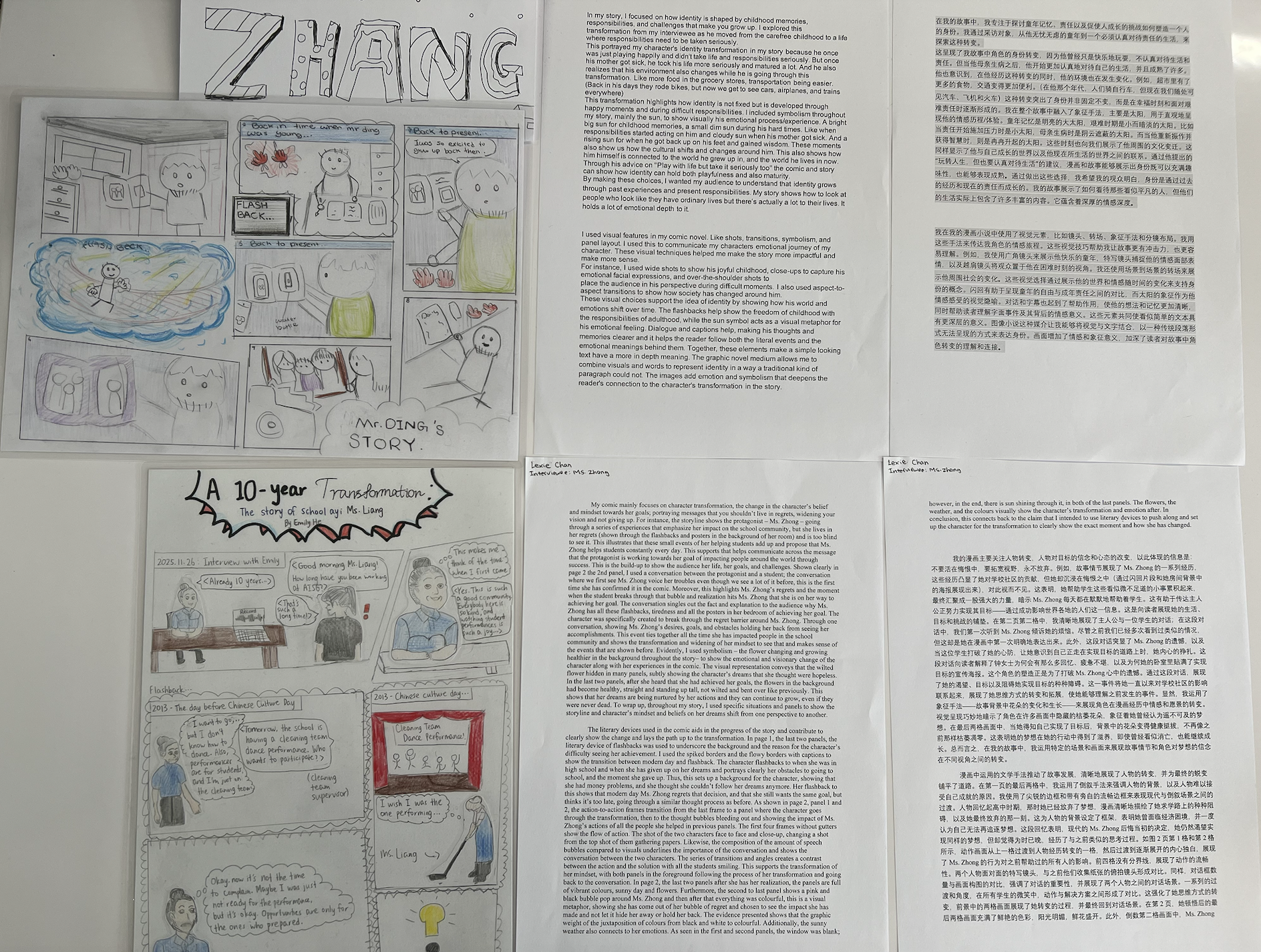
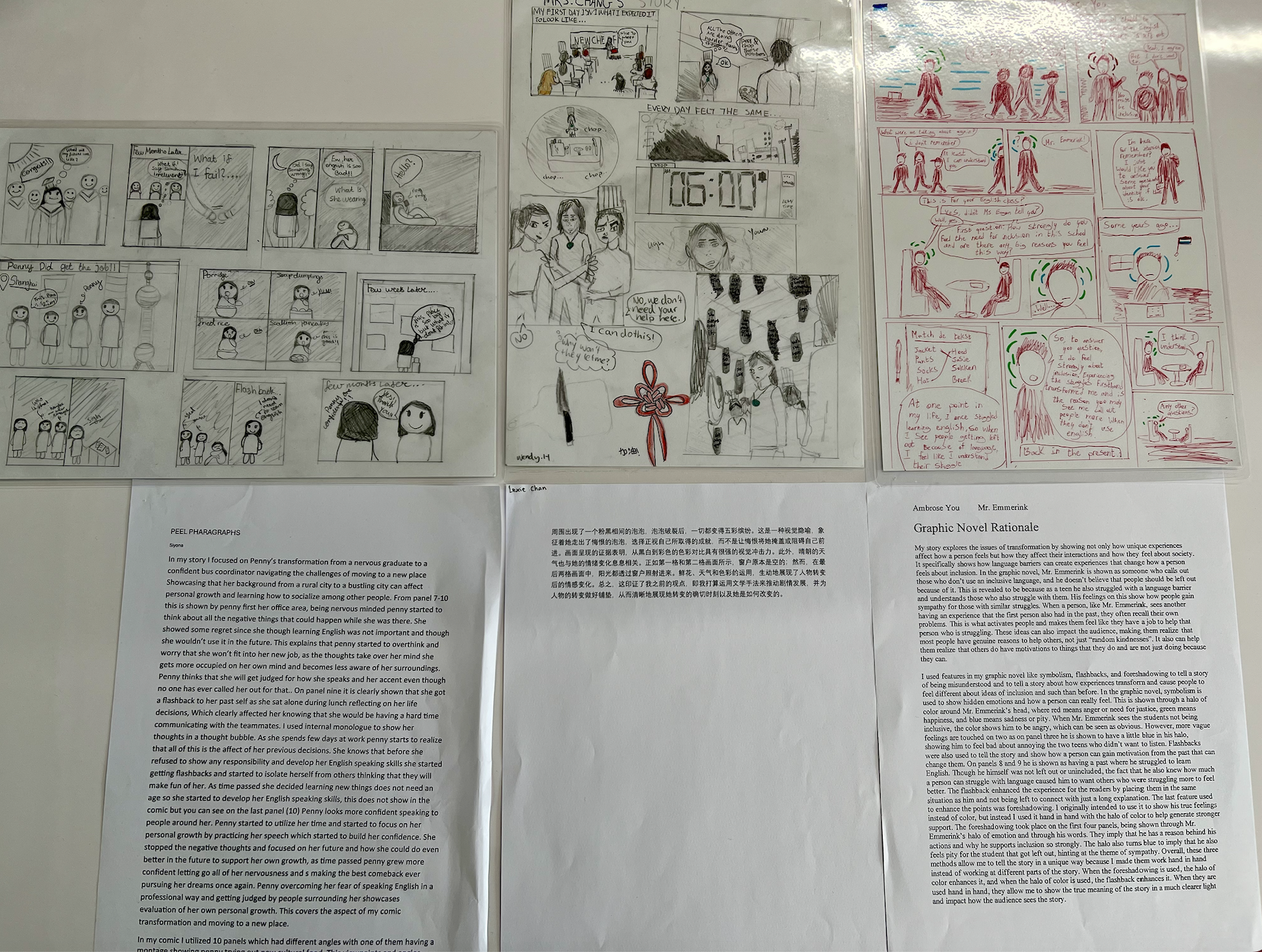
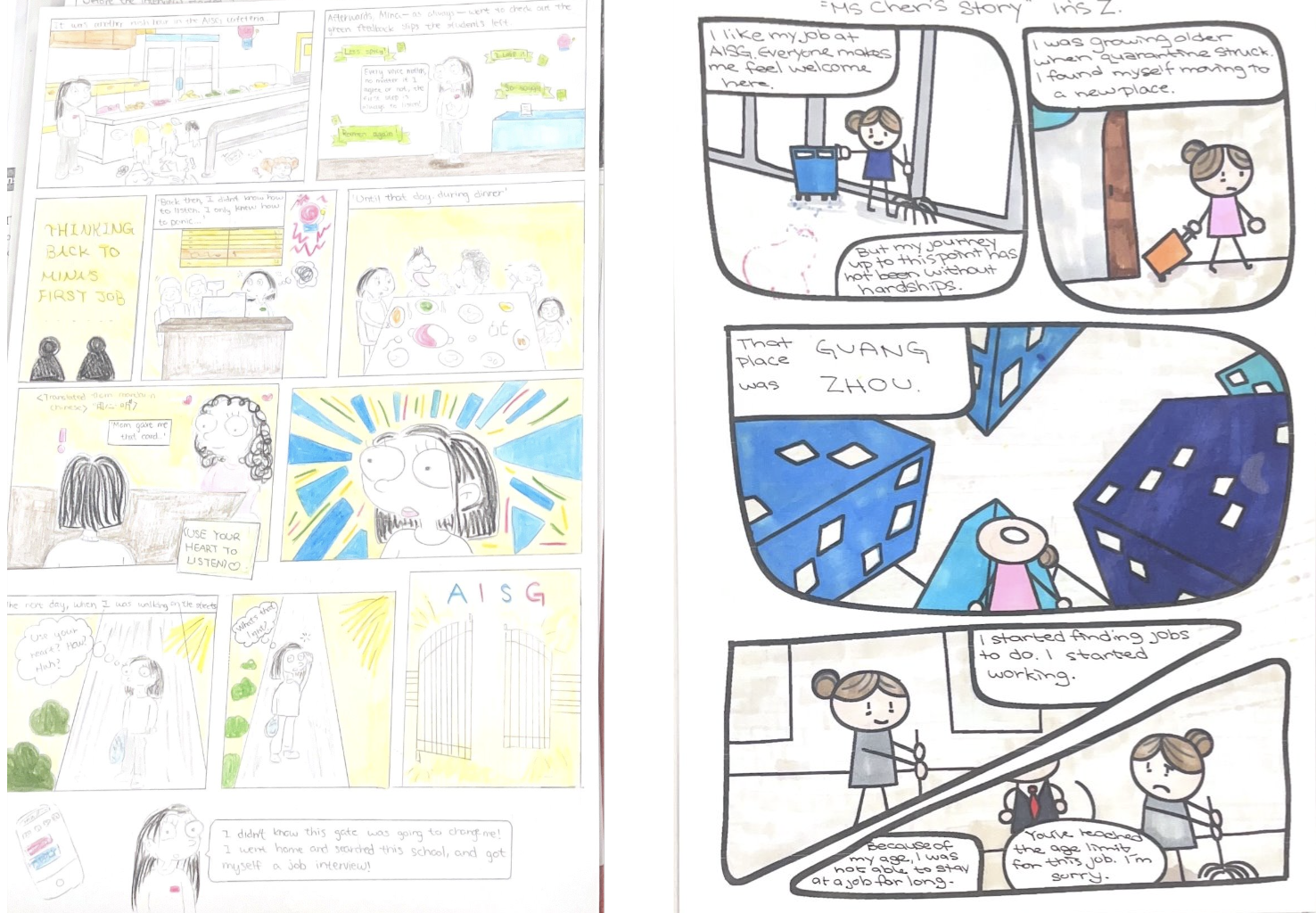
Student-created graphic novel panels to capture the stories they heard
A gallery where students shared their panels and reflections with AISG students, leaders, teacher, parents, and community members
A summative assessment involving a deep reflection by the students of what they experienced in connection to key MYP criteria and themes connected to American Born Chinese
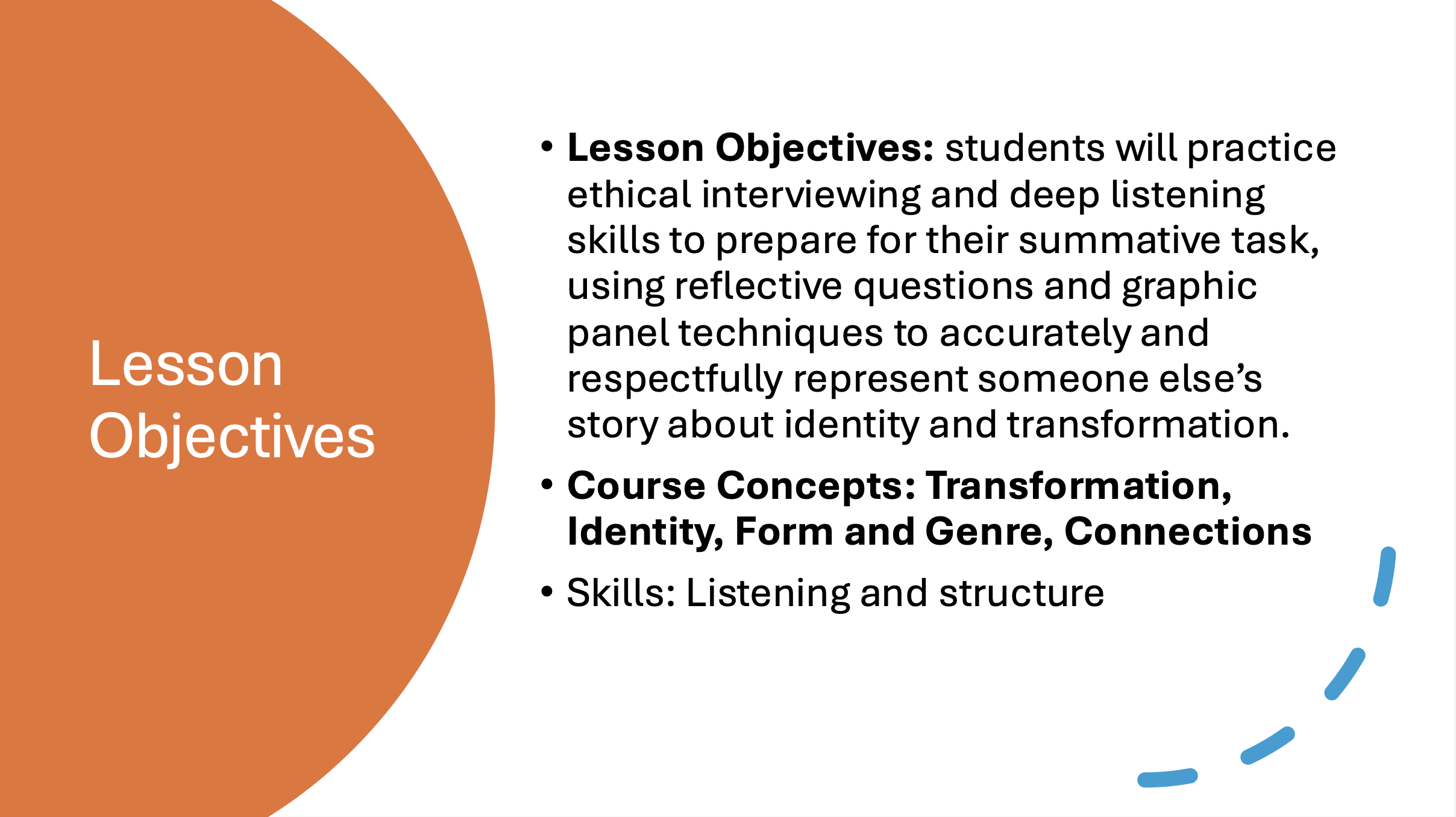
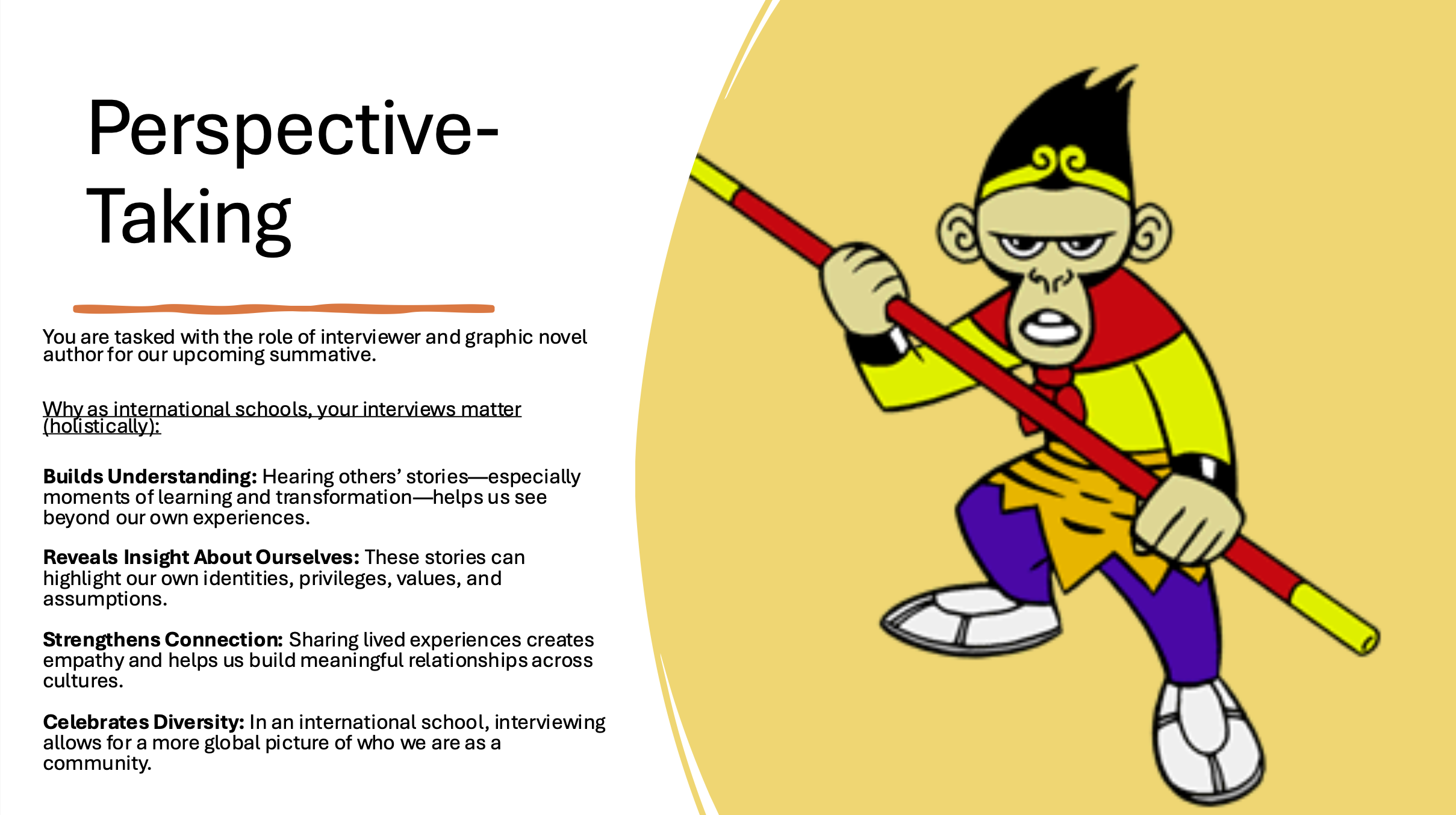
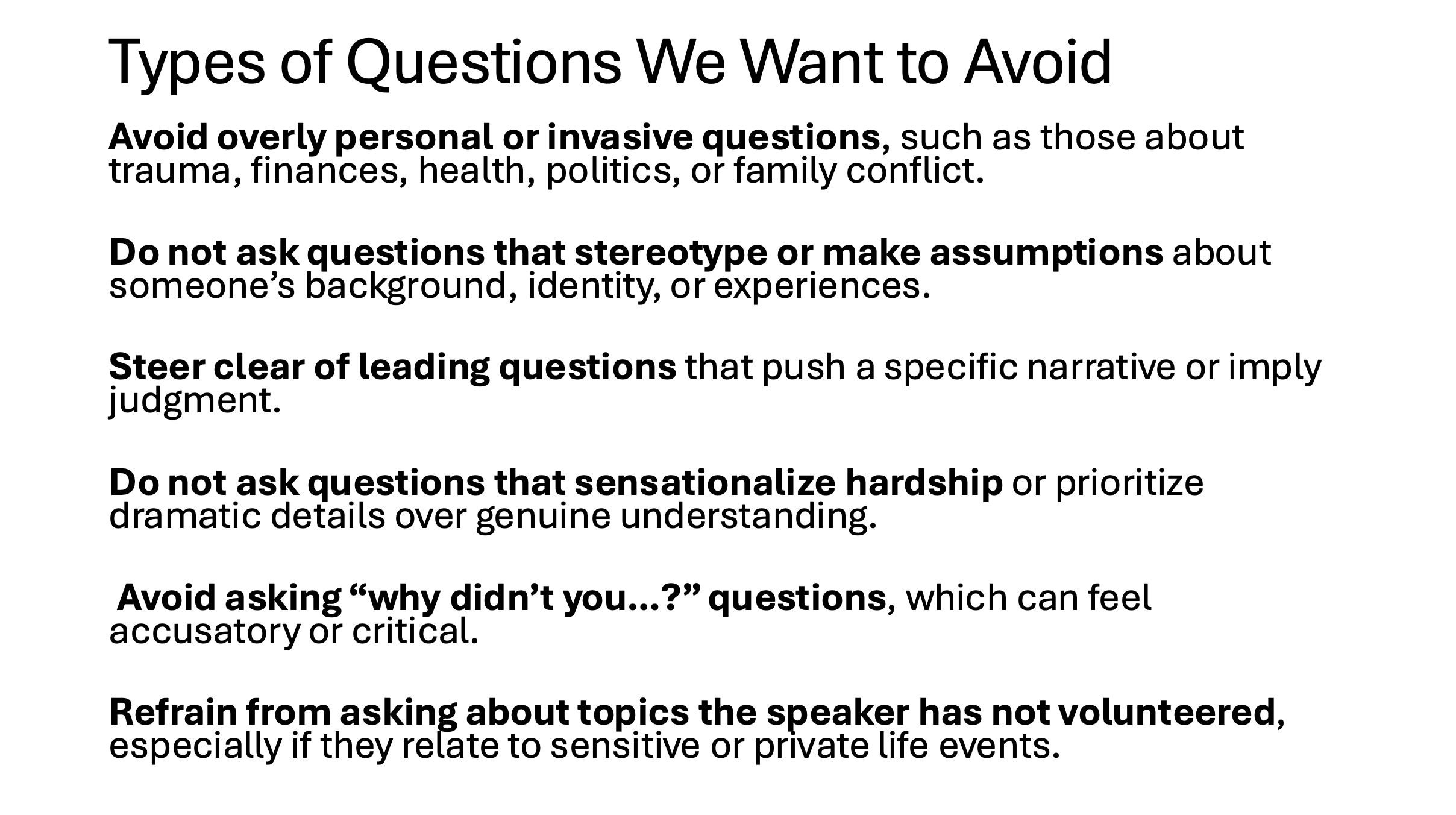
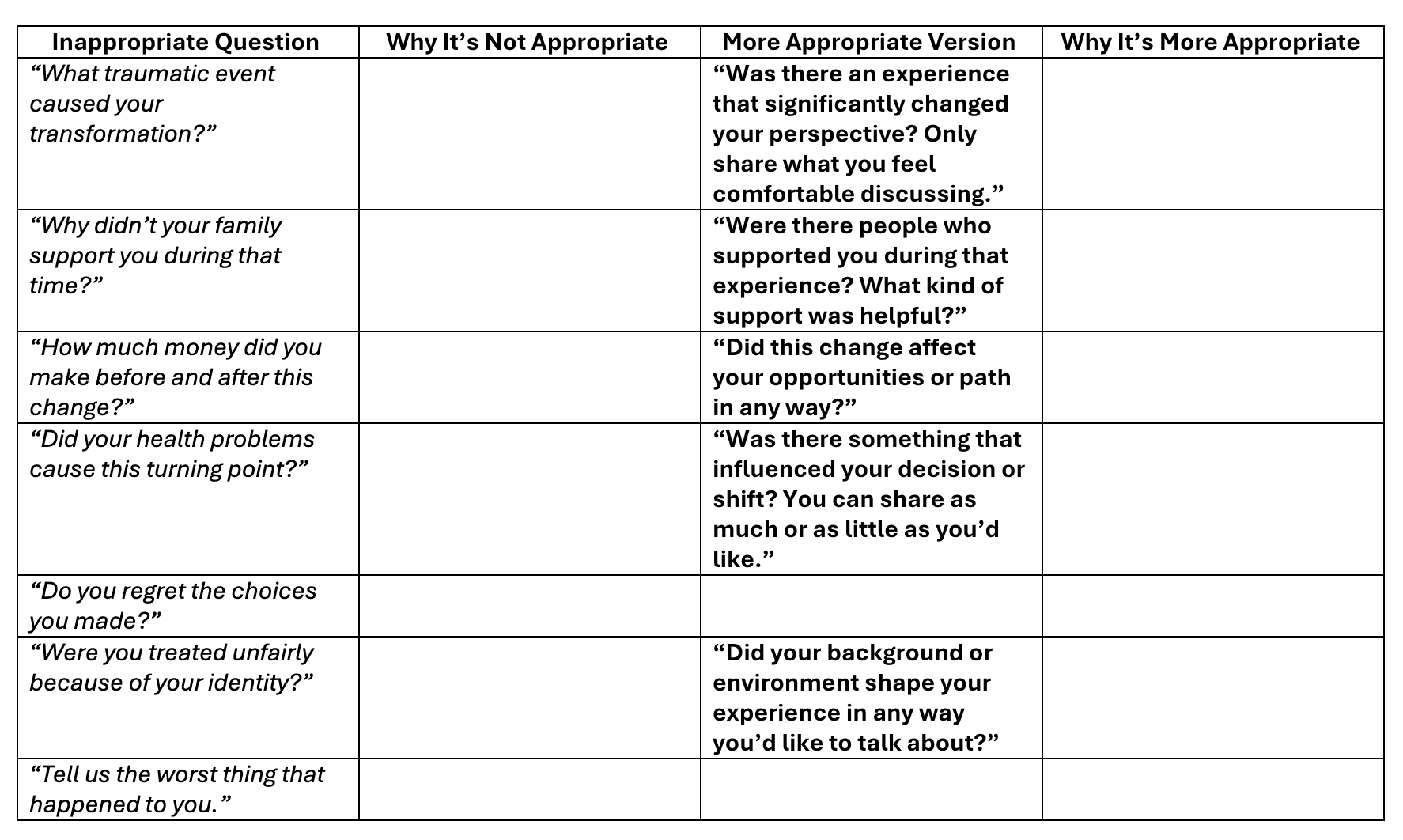
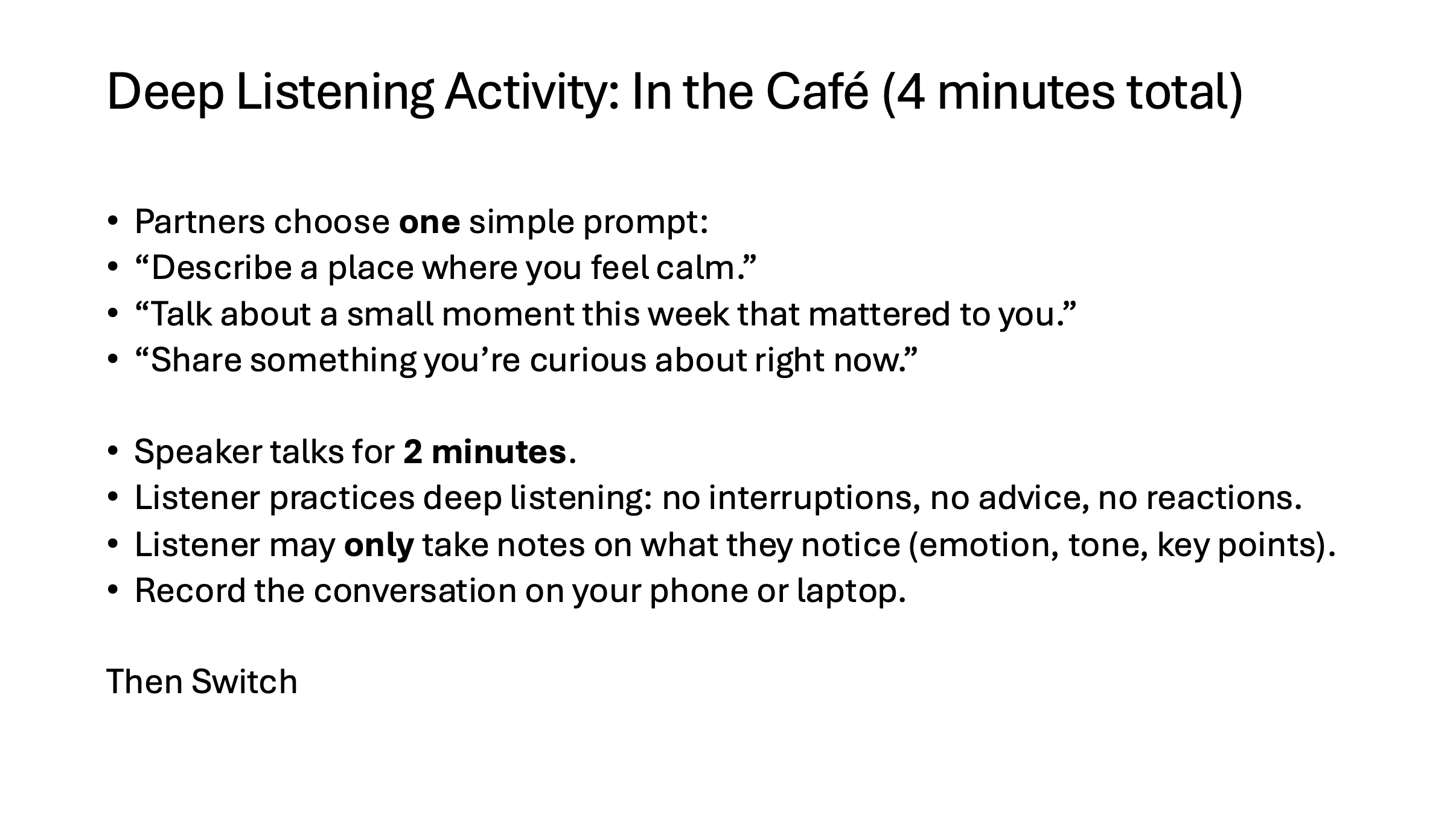
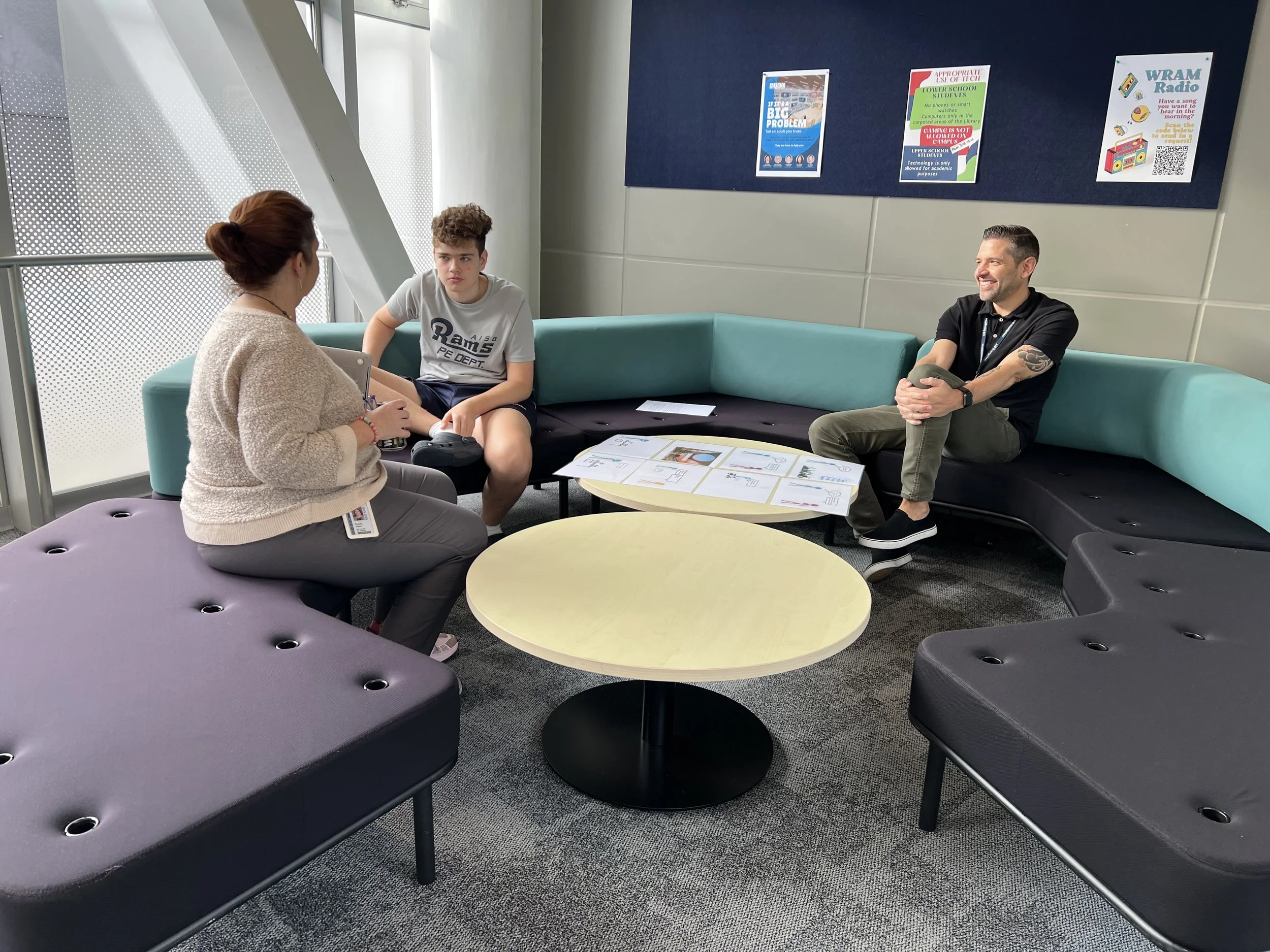
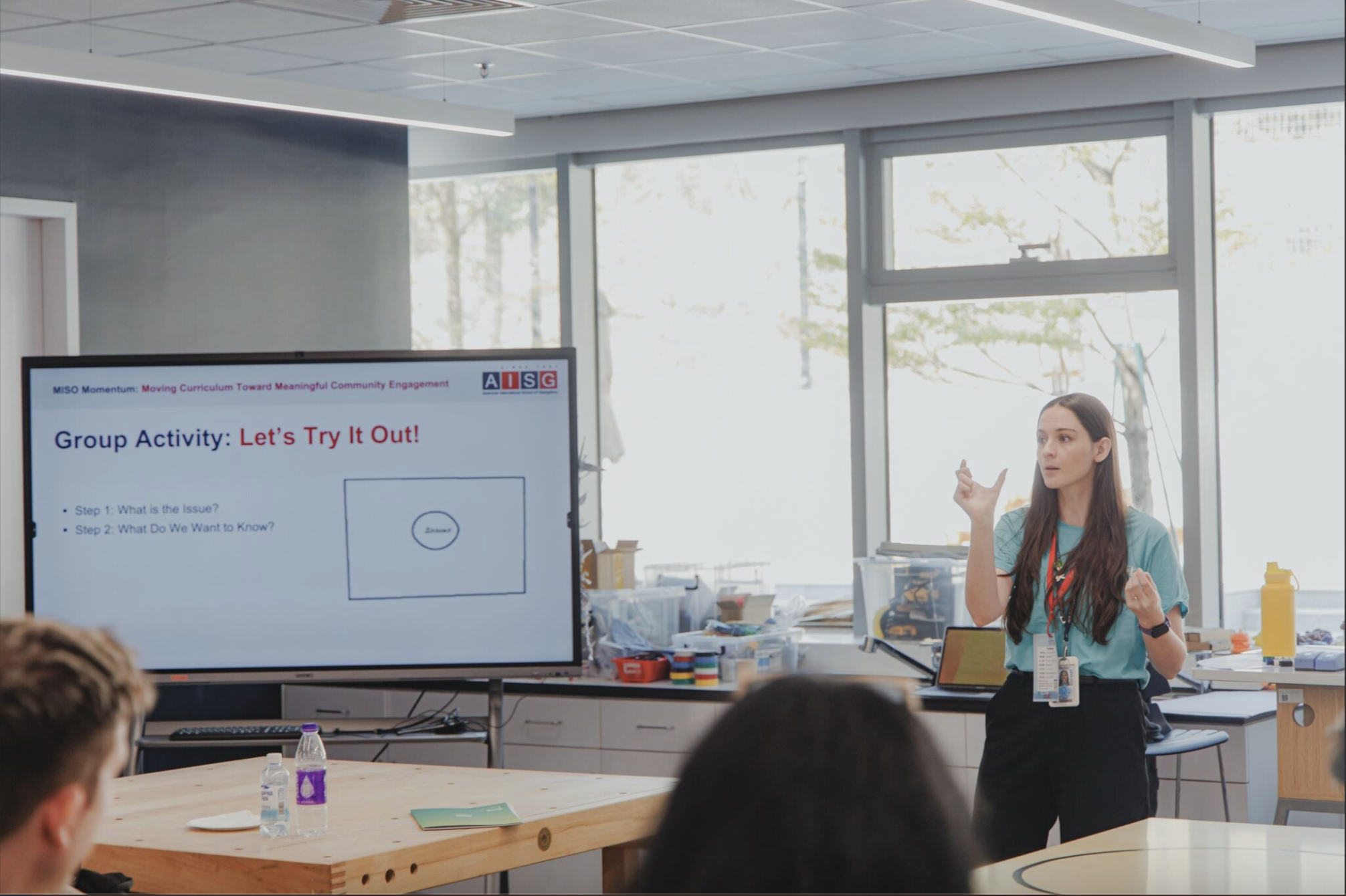
Below: slides from the lesson where Cassie and Burke scaffolded students’ understanding of how to ask appropriate questions, followed by an opportunity to practice deep listening with a peer partner. Last photo, bottom right: one of the student/non-teaching staff interviews that occurred as a peak learning event in the event.
Scaffolding the Skills That Matter
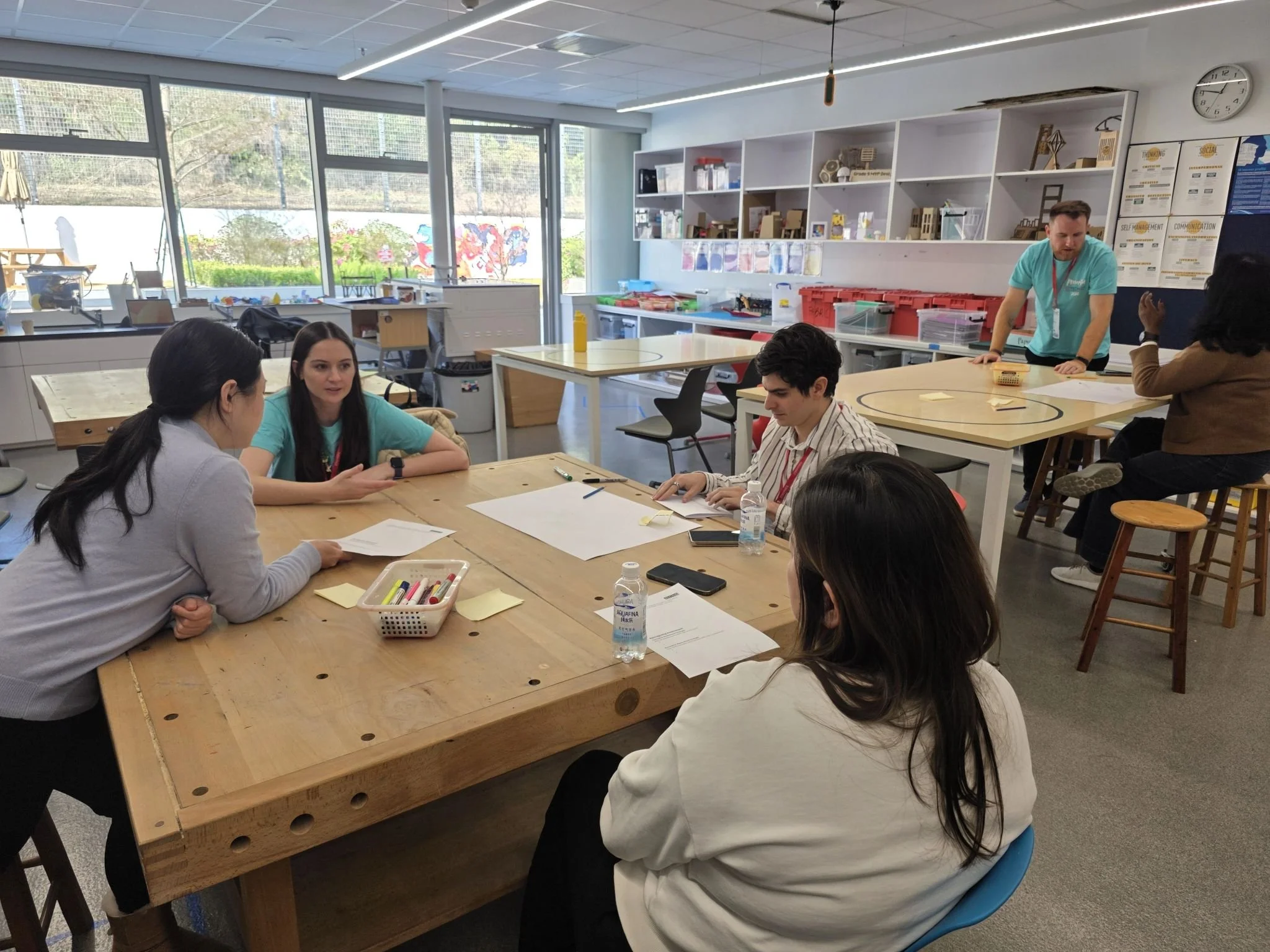
The teachers understood that interviewing and deep listening require intentional scaffolding. Students first learned to distinguish between appropriate and inappropriate questions, and then practiced active listening skills in manageable settings before conducting their actual interviews.
Each student was paired with a staff member from across the school community: ayis (staff members who clean the campus), cafeteria staff, chefs, cafe workers, bus drivers, guards, maintenance workers, and gardeners. The diversity of perspectives was intentional and rich.
Cassie and Burke added another crucial layer: responsibility. Students were coached in representing another person's experience with respect and truth.
"There was this responsibility that both Burke and I emphasized with our students, that you have to set this boundary between an active representation of the interviewee's story and making sure that facts are accurate and that there is no misrepresentation. An ethical approach was key," Cassie explains.
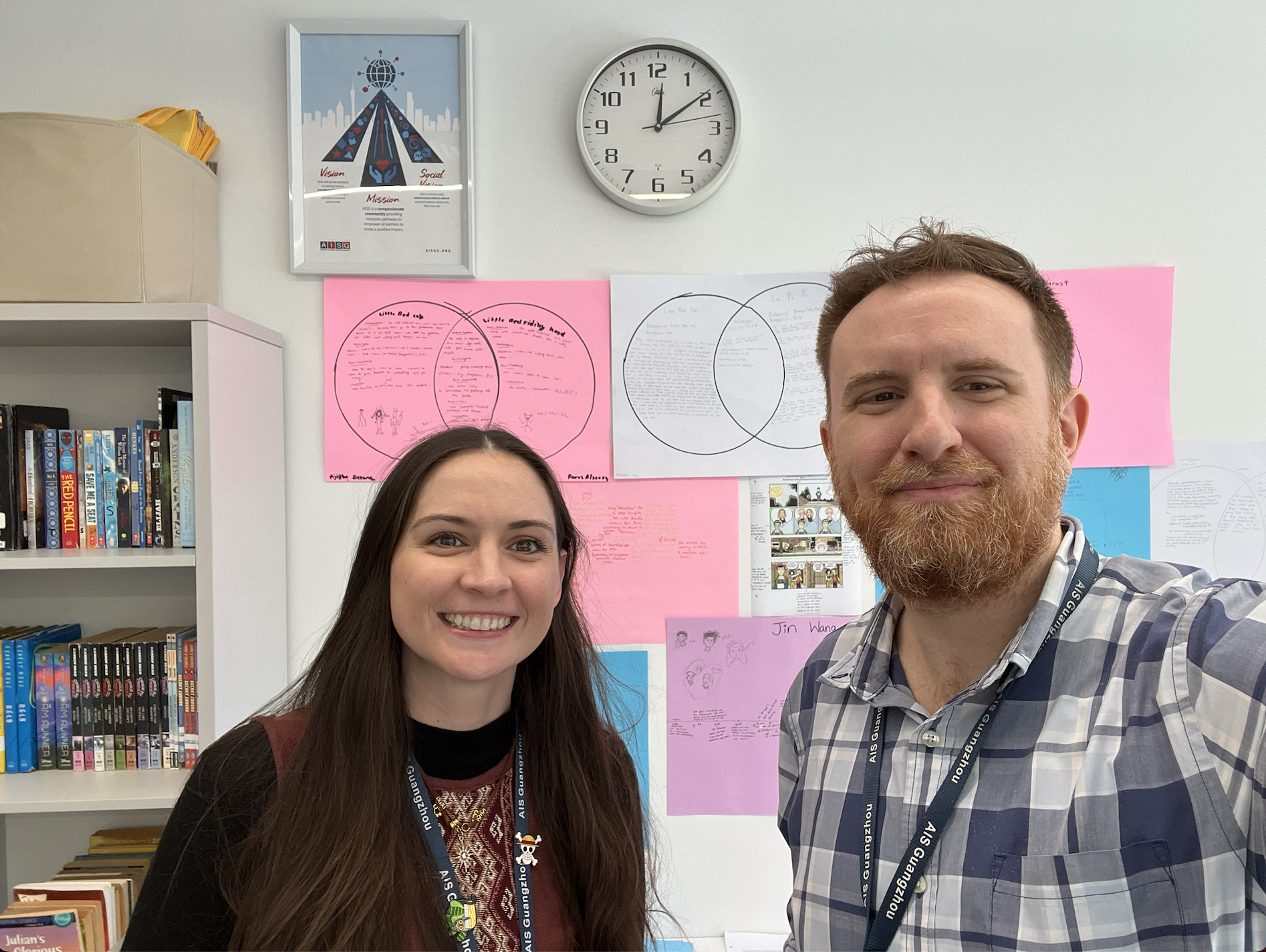
Below: photos from Cassie and Burke’s classrooms during the teaching of the American Born Chinese unit.
From Interviews to Art
After conducting their interviews, students created graphic novel panels that captured their interviewees' stories of identity, belonging, and cultural heritage. These were thoughtful artistic interpretations that required students to make deliberate creative choices about how to honour someone else's narrative. They also allowed students to apply what they had learned about conventions of the graphic novel as a literary form and genre.
Importantly, the assessment focused not on the beauty of the final product but on students' ability to articulate the choices behind their work. Using IB MYP Criterion C (producing text) and Criterion A (analysis), students demonstrated which graphic novel techniques they employed and why those specific choices mattered for telling this particular story.
When Community Gathers
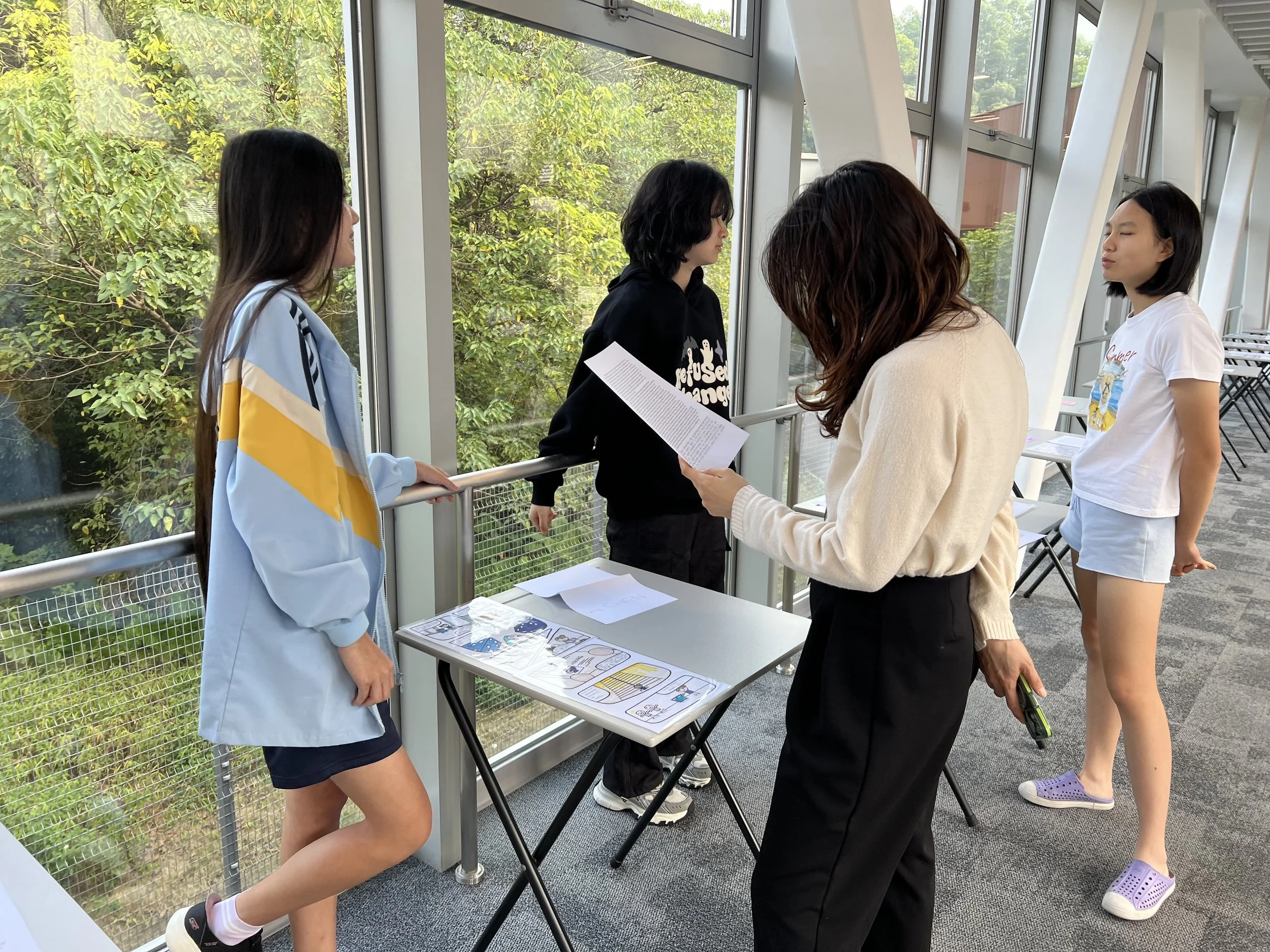
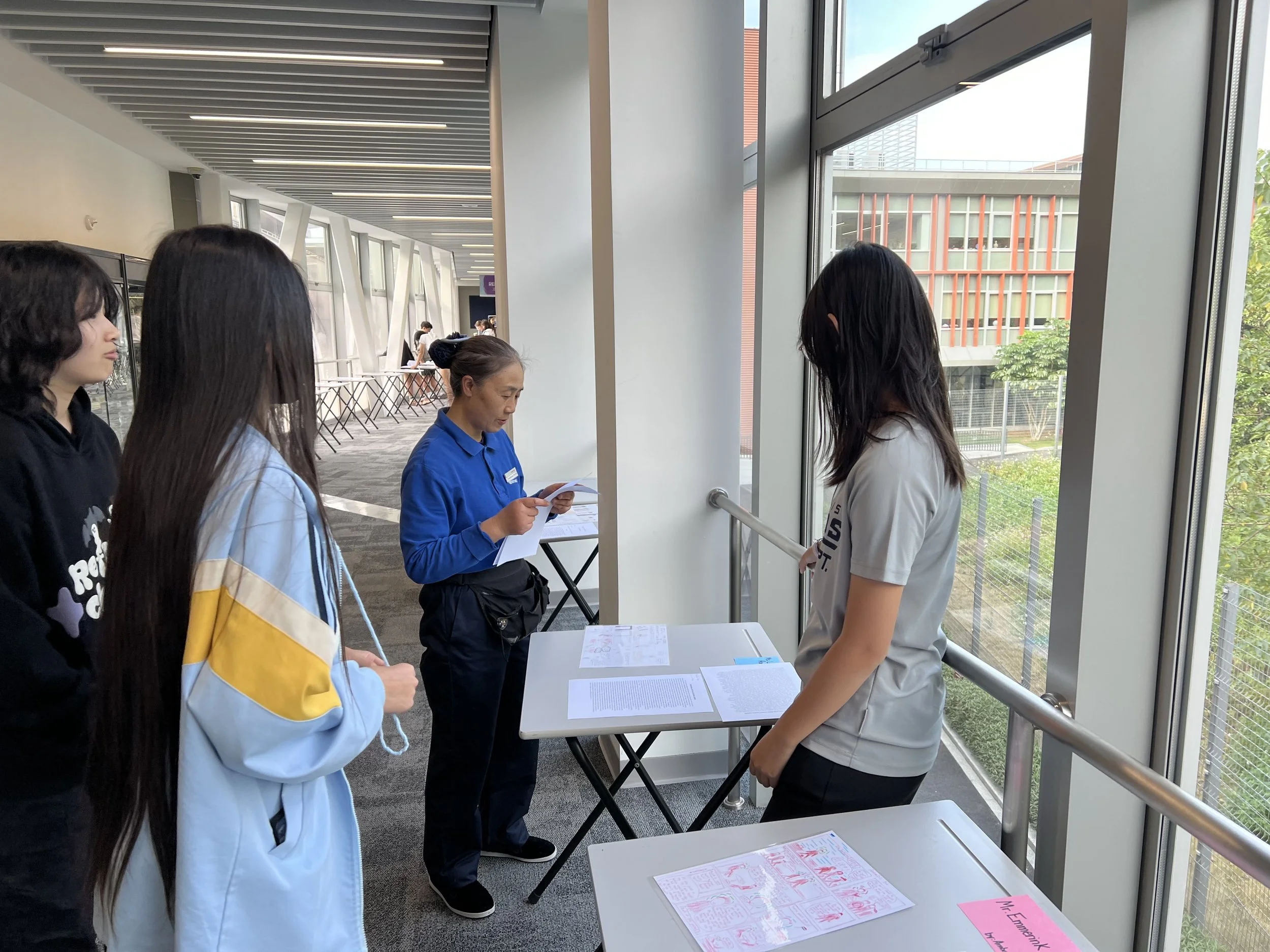
The panels and reflections were curated in a gallery, a key component that revealed the true power of this work. Over 50-60 people came: students, teachers, administrators, the staff members who had been interviewed, and even parents from other divisions who wanted to understand what service learning looks like in practice.
The response from school leadership was particularly meaningful. "I felt very supported by our school's admin team," Burke shares. "We had incredible support from our school leaders for this learning experience. Both Lower and Upper Secondary administrators were exceptionally supportive, and our Assistant Head of School, Jamie Robb, was particularly enthusiastic about the students’ work and recruiting people to come to our gallery."
Teachers who hadn't been interviewed came specifically to read stories about people they see every day on campus but don't know by name. One elementary parent, learning about curricular service learning for the first time, voiced an important realization: the need to extend understanding of these practices beyond the classroom to the entire community.
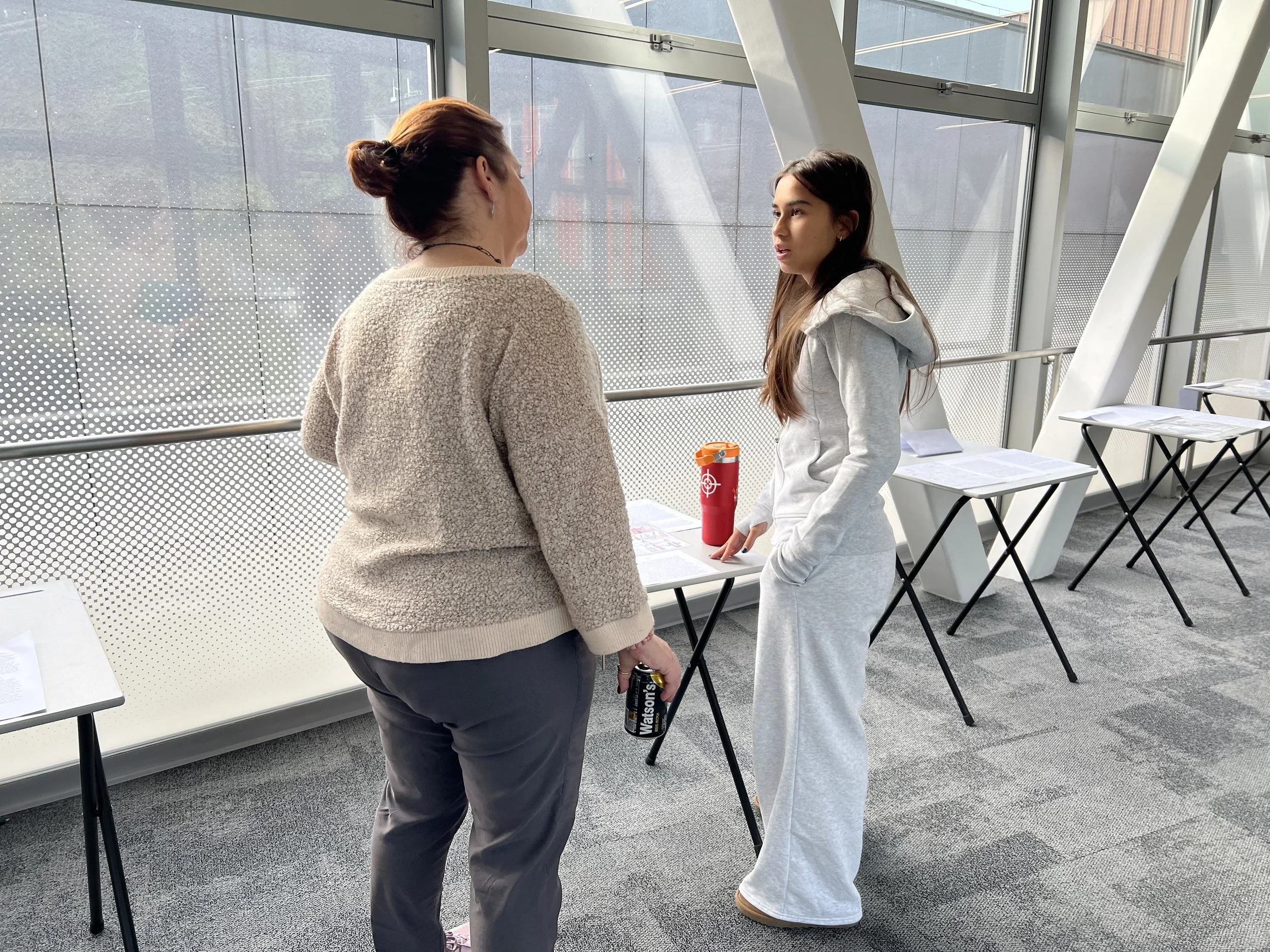
And the students? They actively engaged visitors, welcomed community members, walked them through the gallery, and explained their creative process.
Below: photos from the summative gallery day, where students shared the graphic panels they had created, as well as some examples of the panels and final reflections.
Moments of Transformation
Perhaps the most powerful moment came early in the process. When Burke first explained the assessment, one student asked bluntly: "Why do I need to talk to these people?" The question, while painful, was honest and revealing.
"There is the frustration of the classist undertones in a statement like that," Burke reflects. "But at the same time, when you don't have community engagement built into the curriculum, and those opportunities aren't as readily available, what might we expect an eighth-grade student to say or think?"
After the interview, Burke checked in with that same student. "He was just like, 'I had no idea. This person to me has always been their job, or what they do. I had no understanding of their context, their background.'"
That shift, from seeing a job to seeing a person, represents exactly the kind of transformation in perspective that Cassie and Burke were hoping for.
Looking Ahead: Building Patterns of Engagement
Both teachers emphasize that this unit isn't meant to be a one-off experience. "If we can find these moments throughout all of our units for the rest of the year, no matter how big or small, we can just get the kids in the habit of ‘this is what we do in English class’," Cassie explains. "This is the pattern. This is the structure. And microaggressions can fade naturally, without explicit conversations with a student about why their behaviour is wrong."
Cassie and Burke are already planning their next unit involving adaptations of fairy tales that will connect the eighth graders with third-grade students on campus, creating another opportunity for meaningful exchange and community-building.
For next year's iteration of the American Born Chinese unit, Burke and Cassie are considering refinements, such as:
gifting graphic panels to interviewees as artifacts of the experience and collaboration after the gallery exhibition
including photos of students with their interviewees to help build face-to-name recognition across the community from the start of the year
The Ripple Effect
Cassie and Burke presented their work in this unit at the school’s recent EdTechGZ conference, extending the impact of this unit beyond their own school. As a result, the cycle of inspiration continues. Just as they were sparked by a story from ICS-Addis Ababa, their story now sparks possibilities for others.
What Cassie and Burke have demonstrated is that community engagement and storytelling are powerful pedagogical tools that deepen understanding, build essential skills, and create the kind of connections that transform school culture. When students learn to see beyond roles to the rich, complex humans behind them, everyone's sense of belonging grows.
As Burke puts it, "It's emphasizing the importance of perspective and empathy and then continuing to have meaningful relationships."
When that becomes the pattern, when those conversations become normal, expected, valued, that's when learning and reflection become truly transformative through intentional relationship- and community-building.