Across the Divide: Deep Listening activates Empathy
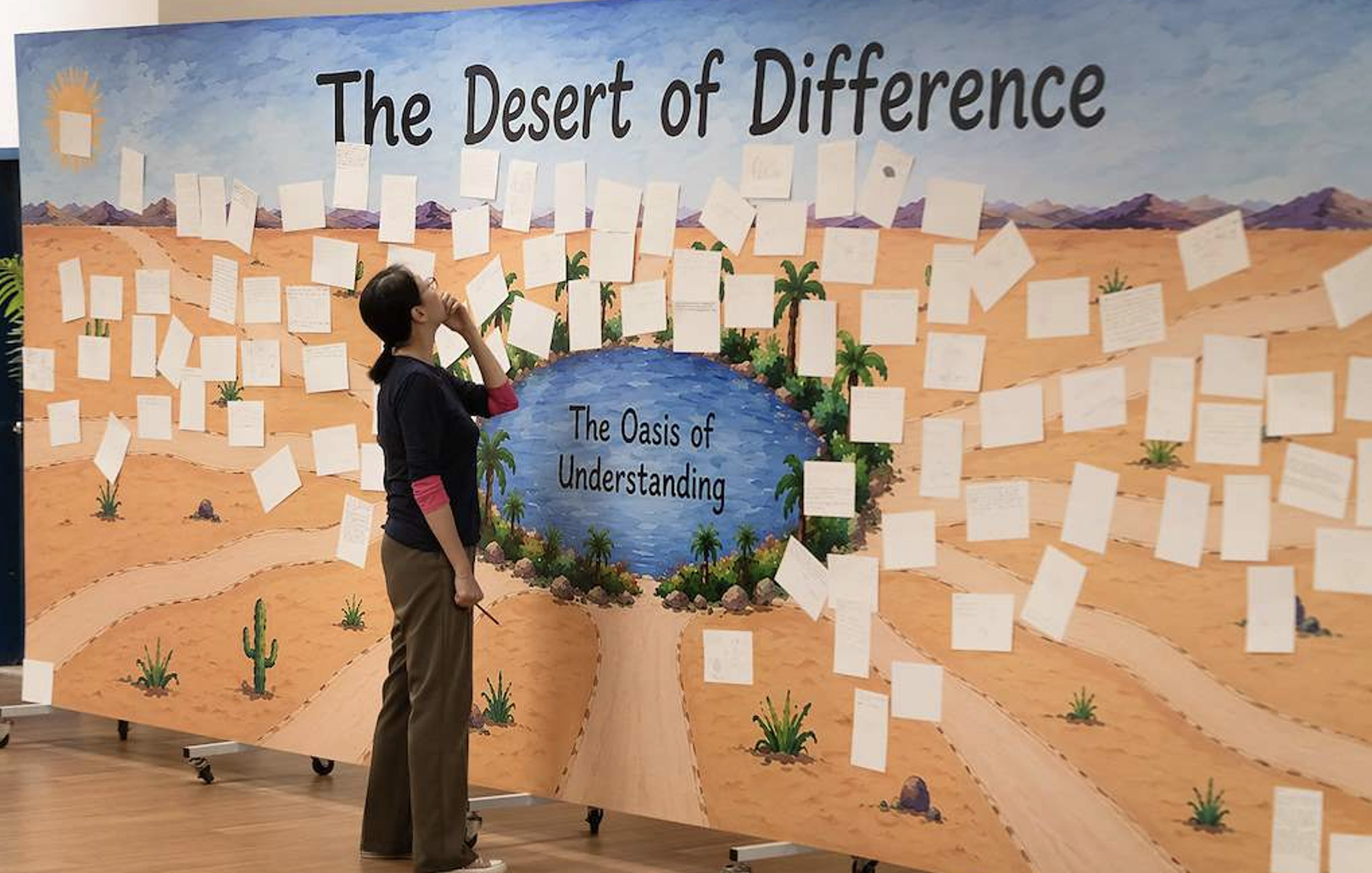
A culminating “Desert of Difference/Oasis of Understanding” pledge wall allowed Year 7 (grade 6) students and participants in the summative Story Exchange to reflect on their experience and think about ways of bridging differences in their own community.
Picture a gymnasium or multi-purpose room where students are sitting in small circles with peers, parents, teachers, and school staff members. One person tells a short story about a time they felt like an outsider, or a time they welcomed someone who felt alone. Everyone else simply listens. A few minutes later, someone retells that story in the first person, as though it were their own, carrying not only the facts but the feeling at the core of the story.
This was the culminating moment of a Year 7 (grade 6) Humanities unit at Green Oasis School (GOS) in Shenzhen. Let’s step into this story, which began with the historical facts of roughly a thousand years ago, in Baghdad, along the Silk Road, and in the religious conflict of the Crusades.
Before the redesign
When educator Gavin Wilson and I first sat down to look at this unit together, he was honest about its design and scope.
“It was a rather typical unit, very much part of a chronological journey from about a thousand years ago to the present day,” he said. “It introduced important ideas and concepts like religious conflict and the interaction of different cultures, but in quite a factual kind of way.”
The content “bones” of the unit were strong: the rise of Islam, Baghdad and the medieval House of Wisdom, the exchange of goods and ideas along the Silk Road, and a set of sources that included a variety of voices and perspectives (which is not always the case in a curriculum built largely on British and European history). What the unit lacked was a bridge between the historical content and a sense of relevance for the students in connection to their lived experiences in 2026. For many learners, the history sat at a distance, interesting but far removed from their day-to-day lives.
A Head, Heart, and Hands approach
Rather than adding a single global citizenship or action layer to this unit, Gavin and I wondered about reshaping the unit around a simple and durable frame: Head, Heart, and Hands.
This is an old (and relevant!) way of thinking about how we learn in authentic and holistic ways. The Head in this educational philosophy represents knowledge. The Heart represents empathy and perspective-taking. And the Hands represent the action that a person may choose to take because of what they know and feel. The three are connected, and in this unit they were held together by a single guiding question that ran from the first lesson to the final pledges that students made:
"What happens when different worlds collide, and how can we build bridges across difference?"
The starting point
As the unit redesign took shape, historical content remained at the core of the learning. In order to make connections to their current, lived context, students needed to understand Baghdad as a centre of learning, the Silk Road as a conduit for goods, beliefs, and ideas, and the Crusades as a period of deep and sustained conflict.
Some of the richest research material came from Gavin's own favourite sources that featured accounts of Christians written from a Muslim writer's perspective. In one, a traveller is reassured by a Christian man living in the Middle East that his food has been prepared carefully, and that same man later steps in to protect him from danger in a market. These stories provided windows of insight into how cooperation surfaces in unsuspecting contexts, and this became an entry point into putting the whole unit into perspective.
From these sources, Gavin helped the students draw a line straight to the present.
“We studied an ethnically and religiously mixed community in Baghdad, or in Jerusalem, at a time when there wasn't a lot of tolerance, and there was a lot of conflict,” he said. “But equally, you could say today in Shenzhen there are a lot of people from different countries and different parts of China. And in the world today there is a lot of conflict, religious in nature, some of it in the same places it was back then.”
Making history personal
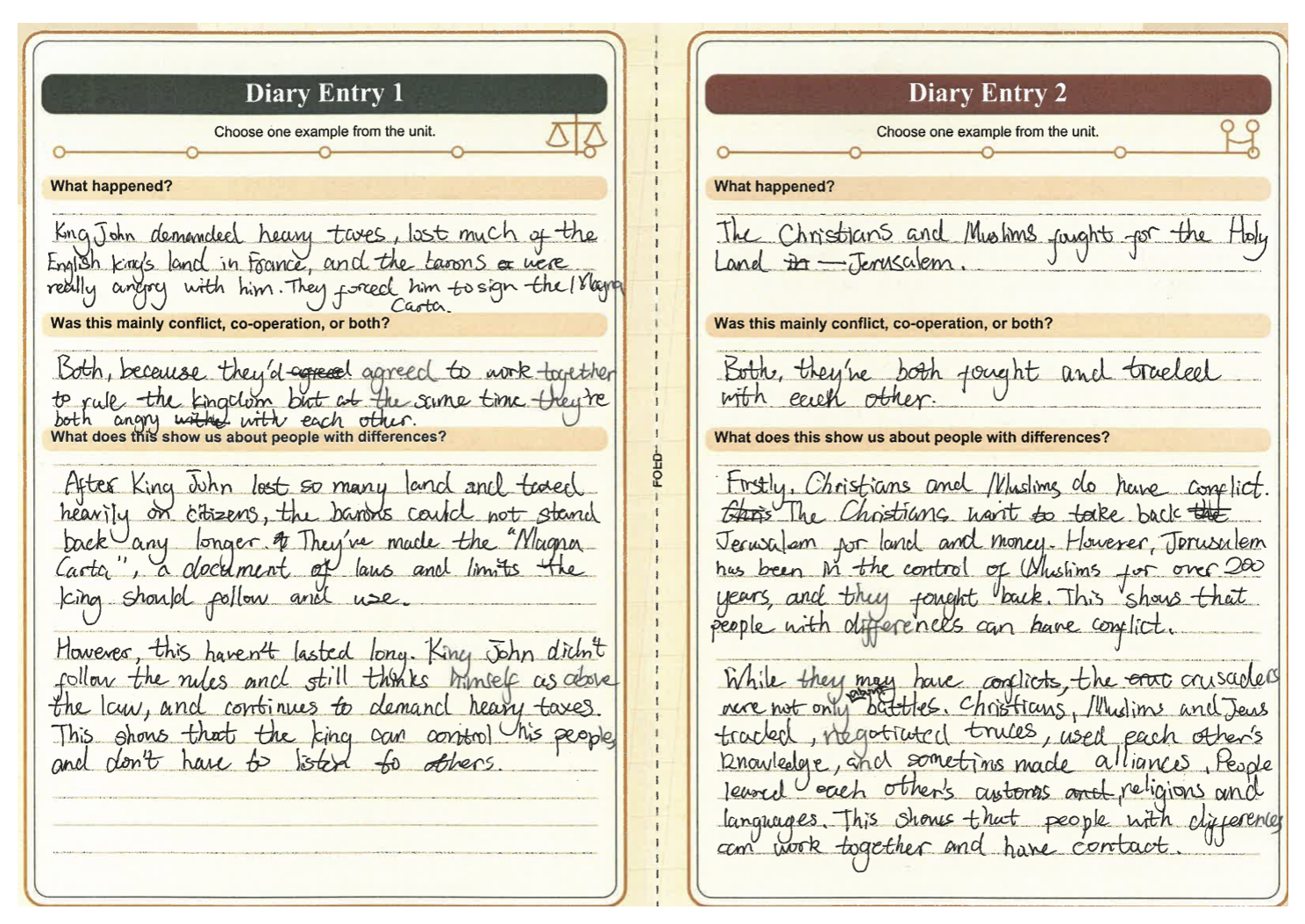
To help students hold conflict and collaboration together, rather than treating them as opposing or irreconcilable ideas, students kept a Conflict and Cooperation diary across the unit, collecting examples from their learning and explaining what each one revealed about how people respond to difference. They wrestled with a genuinely open inquiry question: Was it ever possible for Muslims and Christians, or Easterners and Westerners, to get along? Some students pointed to the evidence and said yes. Others looked at the same history and concluded the differences were simply too great.
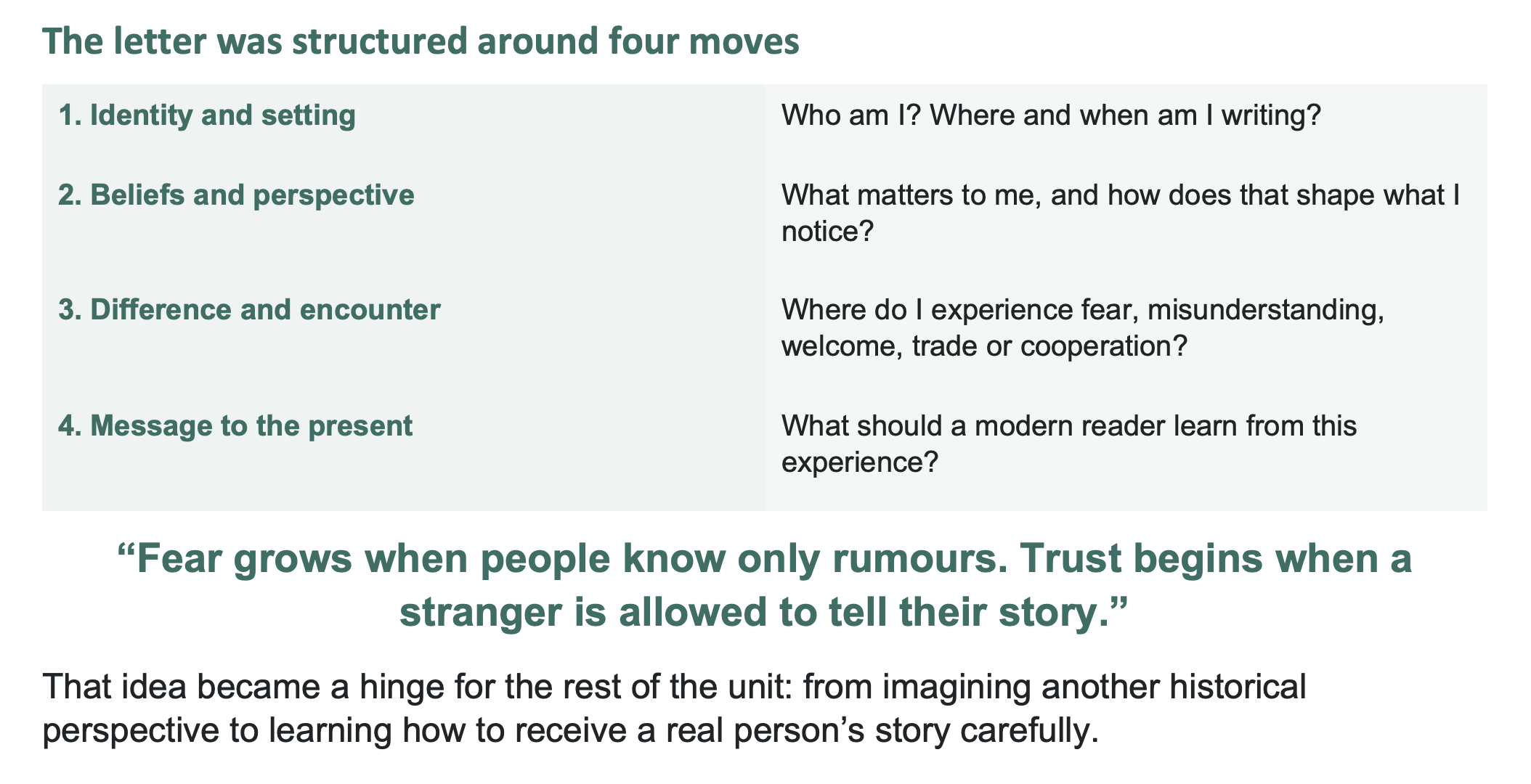
A “Letter Across Time” task then asked each student to write from a historically grounded perspective to a modern reader with a message for living peacefully in the present day. This was an important task for students to synthesize knowledge (from the Head sphere) alongside their understanding of and care about current contexts and events (from the Heart sphere).
What surprised Gavin was how readily students brought their experiences and ideas into the Humanities space.
“News stories emerged every day that students were able to link to our unit,” he said. “It enabled them to see that these themes are universal, and that they are not just rooted in the past but are central to the modern human experience.”
Below: How the “Letter Across Time” was structured, and examples from a student’s Conflict and Cooperation Diary.

Learning to listen
At the centre of this unit, to facilitate students’ action in response to what they were learning and what they cared about, was deep listening practiced through story circles. It is easy to say the words “listen with empathy.” It is much harder to do, and Gavin treated this as a skill to be honed with support and scaffolding.
“I was inspired by the Story Circles in grade 9 at the International Community School of Addis Ababa, and when I read about what they had done, I wondered if we could use the same strategy to support students in connecting across difference,” says Gavin, adding that the practice of deep listening was a natural fit with the unit’s central, guiding question.
The story circles used in both learning experiences were rooted in the Narrative 4 story exchange model. This formal protocol provides a time window for participants, in pairs, to introduce themselves to each other (guided by prompts). After a set amount of time for each partner to share, pairs join up to form groups of four, with partners introducing their partners using first-person pronouns. Partners take on each other’s stories, a task which requires presence, patience, respect, and empathy.
Once Gavin and his team had decided to include a summative deep listening exchange in their unit, the Year 7 students rehearsed in stages.
First, students were encouraged to think of a safe personal story, which they shared with a partner. The partner could ask clarifying questions only after the story was finished, and then the partners would tell each other’s stories while preserving both the facts and the feelings. The protocol was strict on purpose: no interrupting, no note-taking, no rushing to advise or fix.
“Sometimes I wondered if the students had ever sat in silence for a full minute or two,” Gavin admits. Early rounds of deep listening included nervous laughter and retreats into humour as the Year 7 (grade 6) students experienced discomfort with the listening protocol. But their readiness grew, and when older students were brought into the room to participate, the grade 6 students were ready.
“We brought the Year 9 (grade 8) students in and said, ‘now bring them into your story circle and show them how to do it,’” Gavin recounts. “And the students did it quite seamlessly.”
The culminating Global Citizenship Story Exchange took place during the final weeks of school and a campus-wide Global Citizenship Week. Students participated in this Story Exchange in trios with an adult (including parents, support staff, and teachers from across the school), around a single prompt: Think of a moment when you felt like an outsider, or when you welcomed someone who was. What did you learn about yourself or others from that experience? Trios then came together to form circles of six, where each person retold another member's story in the first person. Carrying someone else's experience accurately and respectfully led to profound and authentic reflection and perspective-taking.
After the deep listening experience, individual reflections were gathered on a shared wall, a “Desert of Difference, Oasis of Understanding,” and each student finished with a pledge that completed a single prompt: “Because of what I have practised today, I will…”
The strongest pledges were specific enough to act on, such as “listen before judging”, or “ask questions rather than rely on rumours”; “welcome someone new”, and “show respect while disagreeing”.
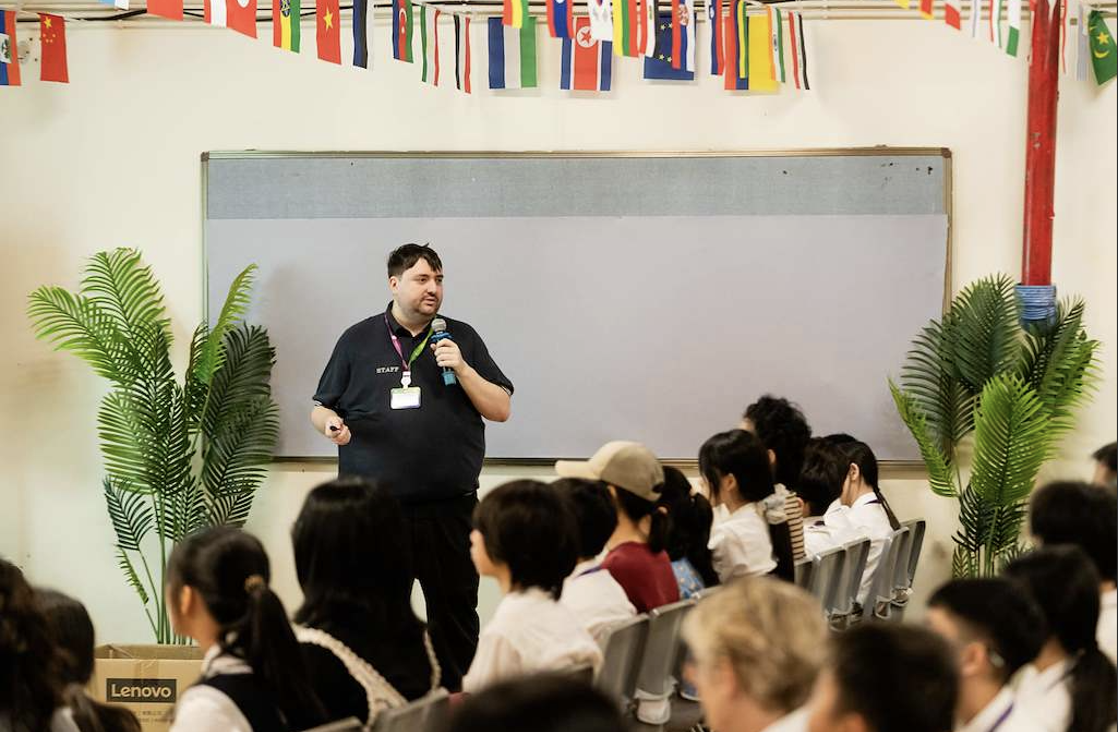
Below: Gavin opening the Story Circle event during the Green Oasis Global Citizenship Week, and students engaged in the practice of deep listening and sharing stories.

Impact for learners
The clearest evidence of impact came later, in the students' own words and choices. Asked whether they would recommend the deep listening experience to the next Year 7 group, they were unequivocal.
“They said ‘definitely, yes’,” Gavin says. “It was an interesting concept and a new way of thinking about history, much more applicable to their own lives, their own conflicts, their own interactions with other people.”
Some students carried their pledges beyond the classroom entirely. Gavin said several students mentioned, without prompting, that they had acted on their pledges over the summer. One told him they had gone on holiday and asked someone about their clothes, their culture, and their food because they were curious and wanted to make authentic connections.
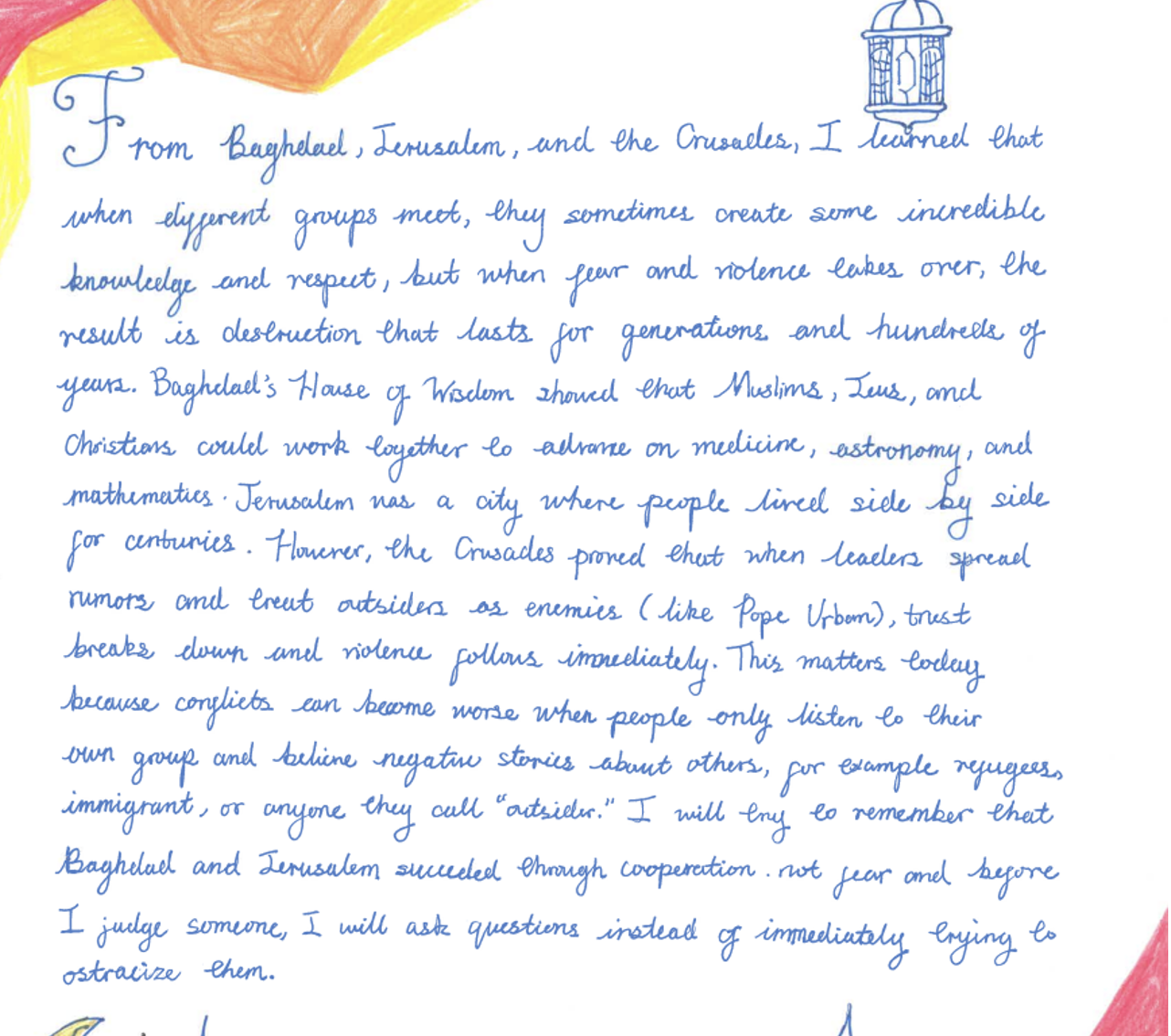
An powerful example of a student pledge.
Impacts for the community
The Story Exchange deeply impacted the adults in the room, too.
“One of the parents stood up and said, ‘This has changed the way I'm going to speak to my child, the way I'm going to listen to my child,’” remembers Gavin. “That was quite incredible to hear.”
None of this planning and prototyping was comfortable at first. Gavin is candid that taking this on stretched him.
“It wasn't something I had any experience with,” he says. “There were times it felt very stressful. However, if you step outside your comfort zone and embrace something new and interesting like this, it can really pay off. Everyone was so positive, and the students had a great experience.”
The shift is now spreading. Where the school’s global citizenship profile may have once felt abstract to colleagues and students, through this type of experience, it is becoming understood and part of the school culture. And there’s a growing understanding that action and active citizenship include things like community-building, self-care and wellbeing, and authentic individual and collective reflexivity.
That growing shared understanding is already producing new ideas and designs. A colleague with a geography background has designed a sustainability fieldwork lesson in a current Year 9 (grade 8) unit on natural resources, where students will gather data from around the school about water use, lighting, and energy waste. This action research turns an abstract topic into something local and practical. In this way, the successful redesign of the “Islam, Baghdad and the Crusades” unit, moving the study of history from abstract to lived, is quietly reshaping additional units this year. It’s a domino effect that infuses the curriculum with the spirit of the school mission and vision.
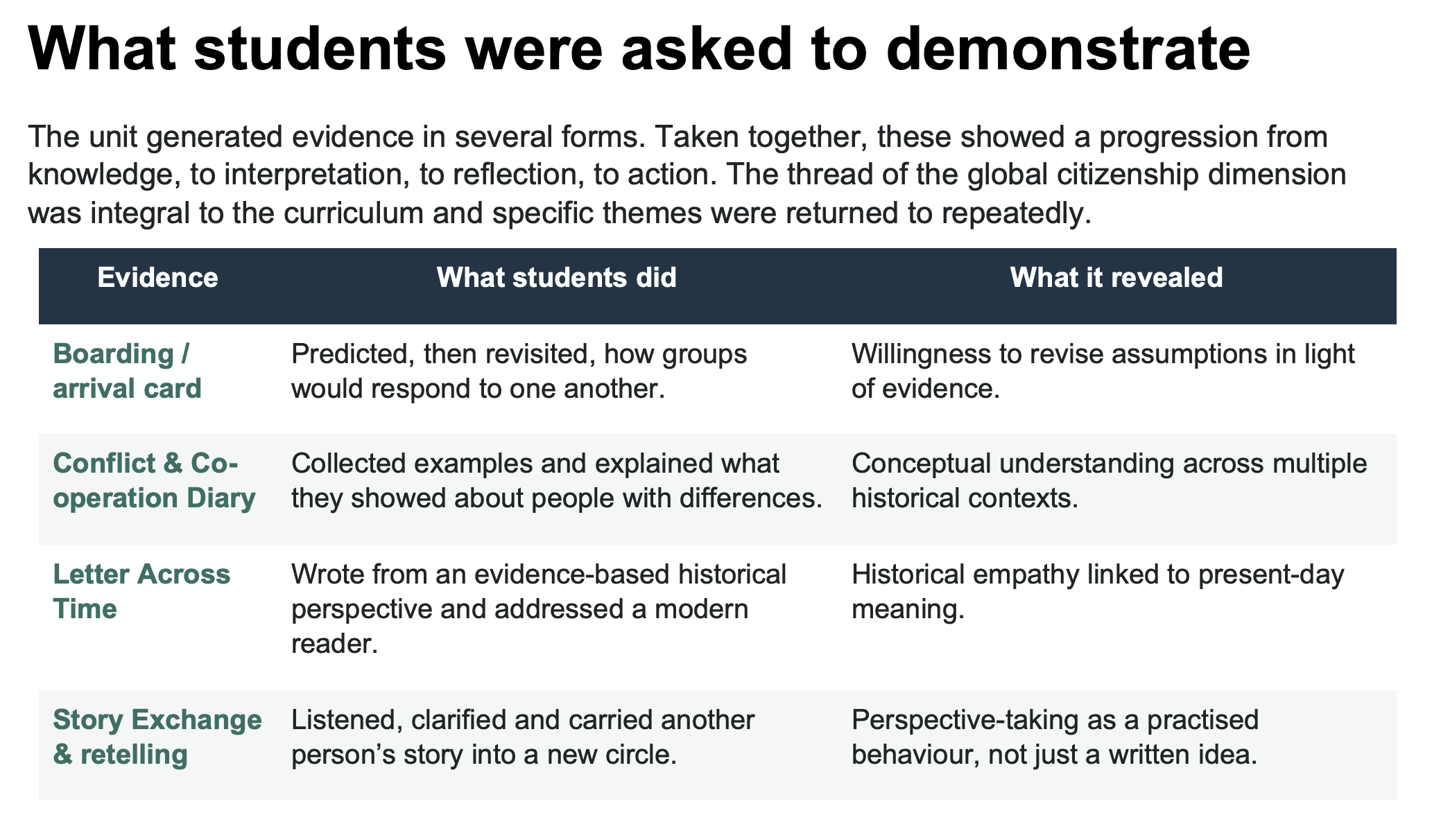
A snapshot of ways that students demonstrated learning, reflection, and application of content knowledge throughout the unit.
From conflict to bridge-building
The most important thing the redesign achieved is that conflict and cooperation stopped feeling like opposites. Students met these ideas in the unit’s source material, tracked them across time, tested their own assumptions, listened to real people, and named one concrete way to build a bridge in their own community.
That is what turns a history unit into a local/global citizenship experience. Learning and knowledge acquisition in the unit remain rigorous, empathy is authentic, and the final question is no longer “What should people do?” but “What will I do differently?”
For a unit that is rooted in history from a thousand years ago in Baghdad, that is a remarkably present-tense place to end.
Gavin has created an extensive sketch of this unit and its outcomes, and you can learn more about his pedagogical approaches and the unit’s impacts on learners and the community HERE.